

Vladimir Kramnik
Vladimir Kramnik · Russia · 1975
The man who beat the most unbeatable champion in chess history with a defensive wall called the Berlin.
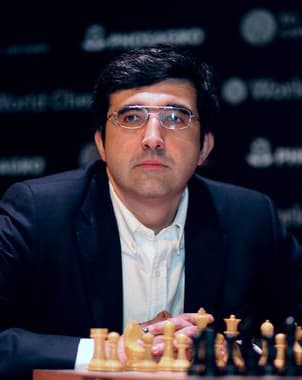
Photo by Vladimir Barskij · CC BY-SA 3.0 · Wikimedia Commons
A prodigy from the Black Sea coast
Vladimir Kramnik was born in 1975 in Tuapse, a coastal town on the Black Sea in Russia. His parents were both artists (his father a sculptor and his mother a pianist), not professional chess players; but that artistic home made Kramnik used to deep thinking and creativity from childhood. His talent in chess showed very early, and he developed in the famous chess schools of the former Soviet Union, where at the time he had the best coaches and the toughest competition in the world.
At 18 something happened that made Kramnik's name known: Garry Kasparov, the reigning world champion, recommended him as a member of the Russian team for the 1992 Chess Olympiad, when Kramnik wasn't even a full grandmaster yet! That strange trust Kasparov placed in an unknown teenager showed that the greats of chess had seen something special in Kramnik's play from the start.
With the outstanding score he got at that Olympiad (8.5 out of 9 possible games), Kramnik proved to everyone that the trust hadn't been misplaced. That early success sped up his climb to the highest level of professional chess far faster than usual, so that by the early 1990s Kramnik had become one of the top five players in the world, before even turning 20.
A wall called Berlin that stopped an empire
The year 2000 wrote Kramnik's name in chess history for good. At that time Garry Kasparov was not only world champion but undoubtedly considered the strongest chess player in history, and most experts thought no one could stand up to him. But Kramnik had a clever plan: the constant use of an old, little-used defense called the "Berlin Defense" against Kasparov's opening moves with the white pieces.
This defense was so dry and tiring for Kasparov that it was nicknamed the "Berlin Wall"; because just like the real Berlin Wall, Kasparov found no way to break through and create danger. The result was that in the 16-game London match, Kramnik beat Kasparov with 2 wins, 13 draws and no losses and became the new world champion; an outcome that shocked everyone, since Kasparov hadn't won a single game!
Interestingly, Kramnik had prepared this strategy in complete secrecy. His analysis team had worked on this defense in secret for weeks before the match, without any sign of the preparation appearing in Kramnik's earlier games. When Kasparov was surprised by this defense in the first game, it was already too late; he couldn't rebuild his whole preparation system in the middle of a world championship match. That match is still known today as one of the best examples of a "preparation war" in professional chess history; that is, a place where the winner wasn't necessarily the strongest player but the one with the best planning.
The toilet controversy and reunification of the title
After his championship, world chess had a big problem: there were two separate championship titles, the "classical" title that Kramnik held and the FIDE title that other players like Anand and Topalov reached. In 2006 a historic match was held between Kramnik and Bulgaria's Veselin Topalov to finally unify the two titles.
That match is one of the most controversial events in chess history. Topalov's team officially accused Kramnik of going to his private toilet too often during the games, supposedly to use computer help; an accusation for which no evidence was ever found. The affair became known as "Toiletgate" and even delayed one of the games after Kramnik protested. In the end Kramnik won the rapid tiebreak and, for the first time in years, the world championship title was unified again.
That controversy kept coming up in both players' interviews for years afterward and shows the high level of psychological pressure and mistrust that can sometimes arise between two rivals in world championship matches; pressure that can shake even the greatest and most experienced players in the world.
Losing to Anand and the gradual decline of the crown
Kramnik kept the world championship title until 2008, when India's Viswanathan Anand beat him in a decisive match in Bonn, Germany. That loss ended Kramnik's reign but was by no means the end of his career; for years afterward he remained among the best in the world and several times was a serious contender for the world championship matches.
One reason many analysts give for Kramnik's loss to Anand is the difference in the two players' styles; with his speed and variety, Anand forced Kramnik out of his own safe, familiar zone of calm, controlled positions. That match showed that even the best strategists in the world can make mistakes when forced to play faster than usual.
The chess philosopher: a deep, preventive style
If we were to describe Kramnik's style, we'd have to say he was a "chess philosopher", not an aggressive warrior. He loved calm positions, complex pawn structures and long-term planning. Unlike players who look for quick, dangerous attacks, Kramnik preferred first to neutralize all the opponent's risks (which is called prophylactic play), and then quietly shift the position in his favor.
That deep, scientific style meant many of the greatest theorists of modern chess, including in the field of openings, owe a debt to Kramnik's analysis. He always looked more like a scientist solving a mathematical problem than a warrior on a battlefield.
Kramnik was also one of the first world champions to use computer analysis software seriously and professionally for pre-match preparation. That scientific approach, which hadn't yet fully taken hold in professional chess at the time, later became the standard preparation method for all elite players in the world; that is, in a way, Kramnik was a pioneer of the full entry of the computer into professional chess preparation.
A controversial era of fighting cheating
After Kramnik retired from professional classical chess in 2019, he entered a new, debated chapter of his life: a public fight against what he considered "widespread cheating" in online chess. Over several years, openly and without presenting conclusive evidence, he accused several young players and even well-known figures of cheating; something that made many of his peers distance themselves from him and strained his relationship with the professional chess community.
That period changed Kramnik's public image a lot; from a calm, respected strategist to a controversial and sometimes unpredictable figure. Still, no one can take away his chess legacy, especially the historic defeat of Kasparov.
Despite these controversies, Kramnik continues his educational and analytical activities, including working with several online chess platforms to develop smart analysis tools. Health problems, including the diabetes he has battled for years, have also been another reason for his gradual withdrawal from intense top-level competition.
A scientific legacy beyond the controversies
Despite the disputes of recent years, no one in the professional chess world can deny the depth of Kramnik's theoretical knowledge. He was one of the main pioneers of using the Berlin Defense, which is popular even at amateur level today, and his deep analyses of various pawn structures are still taught in top-level chess textbooks.
Kramnik was also one of the first world champions to work seriously on developing chess engines and learning aids; projects aimed at helping ordinary players better understand complex strategic decisions. That combination of playing genius and a scientific mind has let Kramnik, even with the recent controversies, keep his place as one of the deepest thinkers in chess history.
Family life and interests outside chess
Unlike the stiff, completely serious image he has at the chessboard, in his personal life Kramnik has shown great interest in art, history and architecture. He lives in Paris and has said in interviews many times that walking the old streets of the city and visiting museums is one of his best ways to rest his mind after hours of intense chess analysis.
He is also the father of several children and has always stressed that he tries to keep a balance between family life and the work pressure of a former world champion; something that, given the high level of intellectual commitment professional chess demands, is not always easy.
Why should we study Kramnik's games?
If you want to learn how to neutralize even the strongest opponents with sound defense and patience, Kramnik's games are an incomparable treasure. His preventive, deep style is one of the best sources for learning real chess strategy; especially if you want to learn how to completely defuse a dangerous position before it actually becomes dangerous. In Shatrino's Masters' Games section you can replay several of Kramnik's real games.
Replay Vladimir Kramnik's real games
In Shatrino's masters' games section, several of Vladimir Kramnik's real games are available; replay them move by move.
Go to masters' games