

Viswanathan Anand
Viswanathan Anand · India · 1969
The first world champion from Asia; the man who, with speed and simplicity, opened the gate of Indian chess to millions.
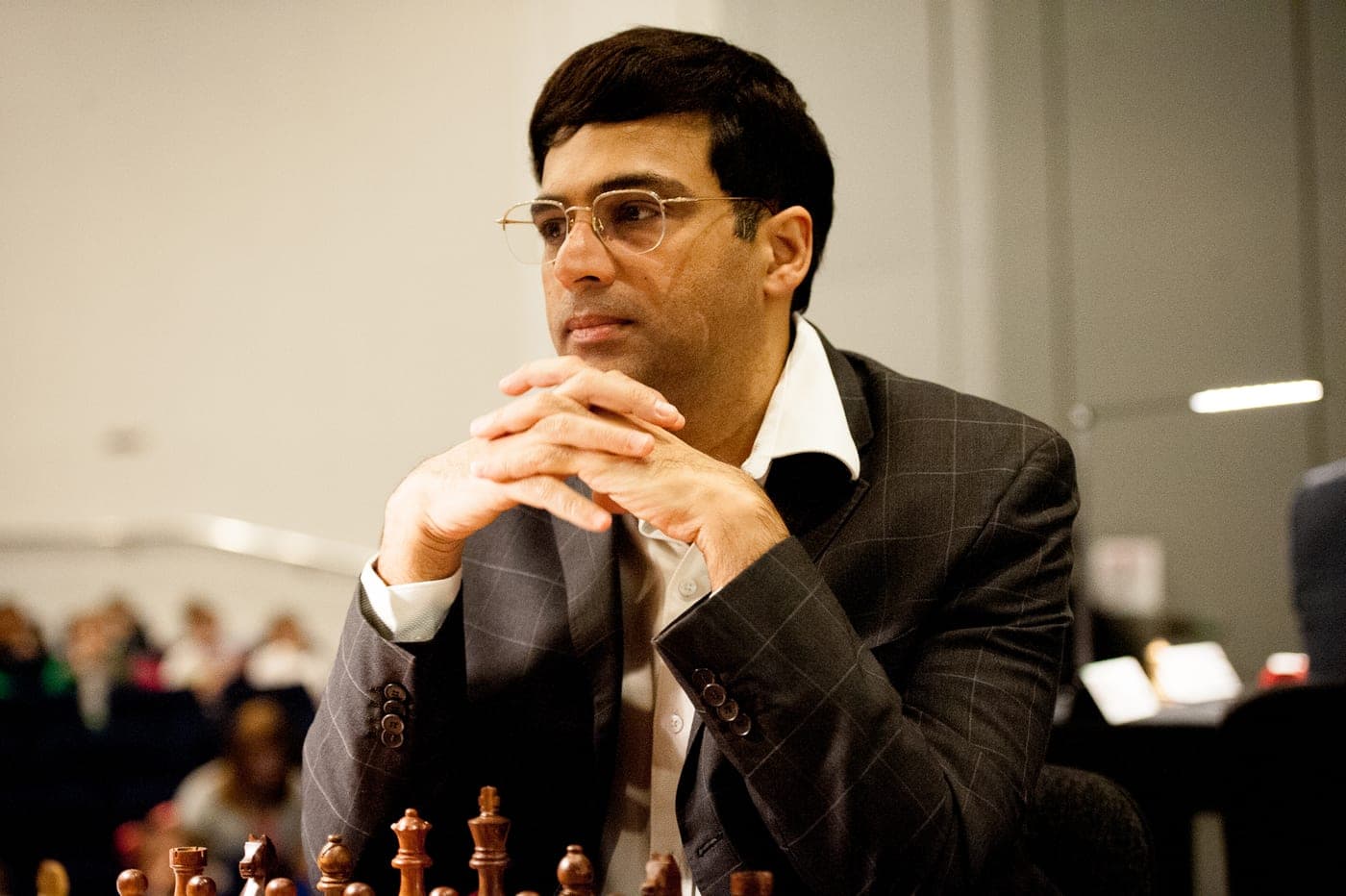
Photo by Wolfgang Jekel · CC BY 2.0 · Wikimedia Commons
A boy from Chennai everyone called the "Lightning Kid"
Viswanathan Anand, known to everyone by the friendly name "Vishy", was born in 1969 in Chennai, India. At that time India was not at all a recognized country in professional chess; there were no Indian grandmasters, and facilities and professional coaches were nowhere near those of Europe and the former Soviet Union. Anand's mother, Susheela, was the first to teach him chess, and she played a very important role in his early progress.
From his teens Anand became famous for his extraordinary speed of thinking and moving, so much that he was nicknamed the "Madras Lightning Kid". In an era when most grandmasters thought for hours on one move, Anand played with confidence and remarkable speed without his quality dropping; a rare combination that quickly drew the chess world's attention.
One of Anand's big challenges in his early years was the lack of access to books and chess resources; something that was abundant for young players in the former Soviet Union but very scarce in India. Anand had to teach himself with whatever source he could find, including old magazines and recorded tapes of the masters' games; an effort that showed his extraordinary will and perseverance.
India's first grandmaster: the start of a revolution
In 1988, at only 18, Anand was recognized as the first grandmaster in India's history. This title, unlike in many other countries that had dozens of grandmasters, was a completely historic event for India, because it showed that a country with no tradition of professional chess could produce its own genius. It sparked a real revolution in India, as Anand became a role model for an entire generation of Indian kids who took chess seriously as a career path.
The Indian government also quickly understood the importance of this success and honored Anand with several national awards, including one of the country's highest civilian honors. That official and public support gradually improved chess infrastructure in India and let the country's chess federation launch more serious training programs for young talents.
A winding road to the championship crown
Anand's path to the world championship, unlike many other champions, was not a straight, simple one. In that era (the 1990s and early 2000s) the chess world had a strange duality: two separate world championship titles existed, the "classical" title that Kasparov and then Kramnik held, and the FIDE title decided by short knockout tournaments. In 2000 Anand managed to win the FIDE title by beating Alexei Shirov.
But Anand became the undisputed, unrivaled world champion when in 2007, in a big tournament in Mexico City, he finished ahead of all the best in the world (including Kramnik) and, without needing a direct match, won the unified world championship title. The next year, in 2008, in a direct match against Kramnik, he proved the same superiority and won decisively.
That victory over Kramnik was also very important symbolically, because Kramnik was the man who had beaten the unbeatable Kasparov years earlier. Now by beating Kramnik, Anand showed everyone that a new era in world chess had begun and that he was, without a doubt, the best player of that period.
Defending the crown: three matches, three wins
After becoming champion, Anand defended his crown in three tough matches. In 2010 he played Bulgaria's Veselin Topalov in a match held in Sofia; Anand had to fight in his opponent's home but won by a narrow margin. In 2012 he played Israel's Boris Gelfand in a match that stayed very close until the last moment and finally ended in Anand's favor in the rapid tiebreak.
But in 2013 everything changed. Anand had to play a young, dangerous challenger named Magnus Carlsen, in his own home city of Chennai. Despite the full support of Indian fans, Anand couldn't hold up against Magnus's modern, precise play and lost. The following year he lost to Magnus again in a rematch and his reign came to an end.
Still, Anand showed that even after losing the crown he was still one of the strongest players in the world. He took part in the 2014 Candidates tournament and won with an outstanding performance; that is, he got the chance to play Magnus again for the world championship. Although he couldn't beat Magnus this time either, that comeback showed Anand's high motivation and ability even in his late forties, an age considered very high for world-class professional chess.
Playing style: a mix of speed, accuracy and flexibility
Over his long career Anand changed his playing style several times, which itself shows his intelligence and flexibility. In his youth he was more of a tactical, aggressive player who used his speed to surprise opponents. But over time his style became deeper and more strategic, and he was able to adapt to newer generations of chess, including the era of computers and powerful engines, something many of his contemporaries couldn't do.
One lesser-known feature of Anand is his extraordinary ability in opening preparation. He always worked with a small but extremely smart team of analysts, and before every important match he spent many hours finding fresh, surprising ideas. That deep preparation several times let Anand surprise his opponents in the very first moves of the game and gain a big advantage.
The father of modern Indian chess
Perhaps Anand's biggest legacy is not his medals and titles but his influence on the new generation of Indian chess players. Today India is one of the world's great chess powers, and several young, extraordinary grandmasters such as Gukesh Dommaraju (the current world champion at the time of writing) and Praggnanandhaa have come out of the country. Many of these young players regard Anand as a role model and even a direct mentor, because Anand has set up various training academies to support young Indian talents.
Despite stepping away from top-level world championship competition, Anand is still active, both as a player in rapid and blitz tournaments and as a coach and inspiration for the new generation. His calm, humble, respected personality has made him one of the most beloved figures in chess history; someone who was never drawn into controversy or arguments and spoke only through his good play.
In recent years Anand has also served as Deputy President of the world chess federation (FIDE) and has played an important role in the broad policy-making of the game worldwide. That new responsibility shows that even after the end of his playing days, Anand still wants to help the growth and development of chess around the world.
The Anand Westbridge academy and India's golden generation
One of Anand's most important initiatives in recent years has been founding the "Westbridge Anand Chess Academy" (WACA), a program that directly provides financial and educational support to India's most talented teenagers. The result of that investment is clear today: India is now one of the world's strongest countries in producing young grandmasters, and several Indian players, including teenage champions, shine at the highest world level.
In his interviews Anand always talks proudly about this new generation and says his greatest joy is seeing the success of the kids he has supported. That long-term, generation-focused view is a main reason Anand is known not only as a champion but as a true architect of the future of Indian and even Asian chess.
A personality everyone liked
One of the least-mentioned things about Anand is that in his thirty-year professional career he has almost never been involved in any controversy or public dispute; something truly rare in the highly competitive, stressful world of professional chess. His fiercest rivals, from Kramnik to Carlsen, have always spoken with complete respect about Anand's calm, composed personality.
In India, Anand has also become a national symbol beyond a sports champion; streets, schools and even curricula have been named in his honor. That level of respect and popularity shows that Anand's legacy, beyond medals and titles, lives on in the hearts of millions of Indians who started chess inspired by him.
Why should we study Anand's games?
Anand's games are a mix of speed, clarity and accuracy; if you're just learning chess, his games are much easier to follow than those of many other champions, because Anand always tried to find the clearest, most direct way to an advantage. In Shatrino's Masters' Games section you can replay several of Anand's real games move by move.
Replay Viswanathan Anand's real games
In Shatrino's masters' games section, several of Viswanathan Anand's real games are available; replay them move by move.
Go to masters' games