

Robert James Fischer
Bobby Fischer · United States · 1943
An American genius who, at the height of the Cold War, stood alone against the entire Soviet chess machine and won.
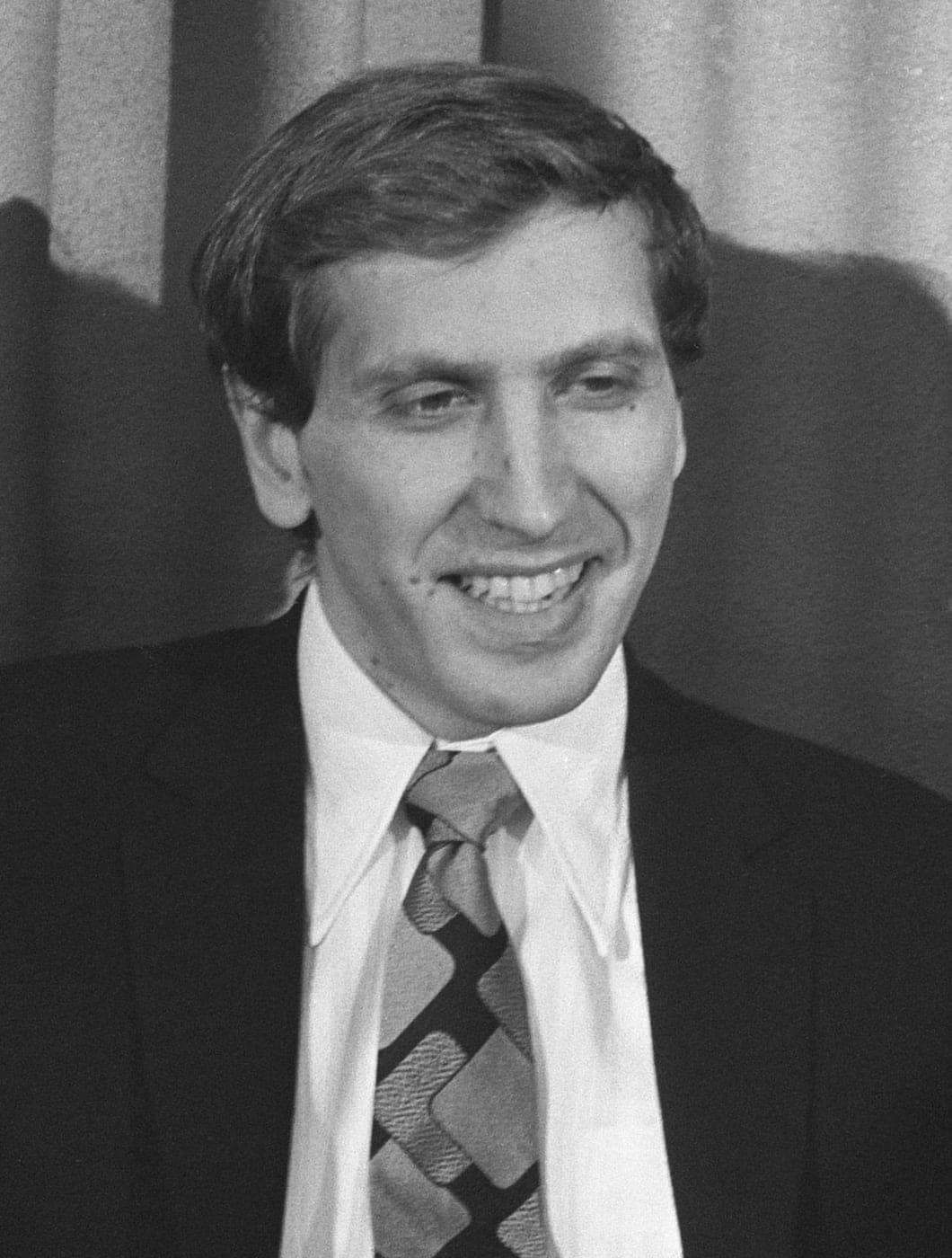
Photo by Bert Verhoeff / Anefo · CC0 · Wikimedia Commons
A childhood alone with a chess set
Bobby Fischer was born in 1943 in Chicago, USA. His family life was complicated from the start; his mother, Regina, raised him alone and the family moved constantly between different American cities. Fischer learned chess at 6 with a cheap chess set his sister Joan bought him. Very soon chess became the only thing Fischer truly cared about; he dropped out of school at 16 to spend all his time on chess, and he famously said: "It's just me and the 64 squares."
His mother, Regina, despite hard financial circumstances, did everything she could to give Fischer access to the best coaches and chess books; she even wrote letters to American officials on the teenage Fischer's behalf to get financial help for travel to international tournaments. Those sacrifices by his mother played a big part in shaping the professional Fischer, though their relationship gradually cooled in later years.
A record that is still unbelievable
At 14, Fischer became United States chess champion, the youngest ever to hold that title up to then. But his truly unbelievable record came in 1963: in the US Championship, Fischer won all 11 games, without a single draw or loss; a perfect, unmatched score that has never been repeated in professional chess to this day. Those successes led Fischer, as a teenager, to be seen as American chess's greatest hope for competing with the Soviet giants.
At only 15, Fischer also became the youngest grandmaster in history up to that time; a record that stood untouched for decades until players of later generations, including Hikaru Nakamura and later even younger players, broke it. Still, Fischer remains the youngest to reach that level without any strong institutional support (unlike the Soviet players, who had full state backing).
The Match of the Century: chess in the middle of the Cold War
In 1972 one of the most important events, not just in chess history but in twentieth-century cultural history, took place. In Reykjavik, Iceland, Fischer played Russia's Boris Spassky, the reigning world champion. That match, which became known as the "Match of the Century", wasn't just a chess contest; at the height of the Cold War between America and the Soviet Union, the game had become a political symbol: could a lone American beat the huge, long-established Soviet chess machine?
Fischer, with his strange, unpredictable behavior (such as threatening to withdraw from the match over poor conditions in the hall or the sound of cameras), nearly caused the match not to be played at all; but in the end, with the intervention of important figures such as Henry Kissinger (then US Secretary of State), Fischer agreed to play. He beat Spassky decisively, 12.5 to 8.5, and became the first (and so far only) American world champion in chess. The victory was celebrated in America like an Olympic championship and made chess explode in popularity in the country.
Interestingly, in that same match, Fischer forfeited the second game completely in protest at the noise of the television cameras; which put him behind 0 to 2. Many thought that was the end for Fischer, but with an incredible comeback he won the rest of the match with complete control; a sign of his extraordinary mental strength and focus even under the toughest psychological pressure.
The disappearance of a champion
Just when everyone expected Fischer to keep reigning for years, something strange happened. In 1975 Fischer was to play Anatoly Karpov to defend his title, but because of a serious disagreement with the world chess federation over the match rules, he gave up defending his title entirely. That means Fischer handed his crown to Karpov without losing a single game; and from there he disappeared completely from the professional chess world, and even from public view, for about 20 years.
The dark years and a decline in character
The years out of the spotlight had a strange effect on Fischer. When he reappeared in 1992 to play an exhibition match against Spassky in Yugoslavia (which was then under international sanctions), the US government issued an arrest warrant against Fischer for violating the sanctions and he could never officially return to America. In later years, with extreme and antisemitic statements (despite his mother's Jewish roots) and verbal attacks against America, Fischer completely ruined his public image and drove many of his old fans away.
He eventually took refuge in Iceland, the very country that had hosted his greatest honor, and in 2005 took Icelandic citizenship. Fischer died in Iceland in 2008, at the age of 64 (a symbolic number equal to the squares on a chessboard).
The people of Iceland, despite all the controversies of Fischer's last decades, always treated him with respect and warmth; because to them Fischer was still the champion who in 1972 put their country forever on the map of world chess history. That unconditional acceptance was perhaps the only peace Fischer experienced in the turbulent final years of his life.
A complicated but lasting legacy
Fischer's legacy is a strange mix of dazzling genius and personal tragedy. On the one hand, he is one of the deepest and most accurate chess players in history, whose professional, obsessive style of preparation set a new standard for professional chess. He was also the inventor of a new chess format called "Fischer Random" or Chess960, in which the starting arrangement of the pieces is random so that players have to truly think instead of memorizing theory; a format that is very popular today and that even Magnus Carlsen loves.
Another of Fischer's legacies is his influence on the design and rules of modern world championship events; he always fought for better conditions for tournaments (such as larger prize money for players and better playing halls), and those demands raised the level of professionalism and the standards of major chess tournaments for good; something all professional players benefit from today.
Fischer's 1972 victory also had a strange economic effect on the chess world; before that, professional chess almost never had significant prize money. After Fischer and the explosive popularity he created for the game, sponsors and big cash prizes entered the chess world; that is, in a way, Fischer is the father of today's modern, commercialized professional chess.
A memory that is still alive
Despite the bitter end of his life, Fischer is still known in America and the world as one of the greatest intellectual geniuses of the twentieth century. Many documentaries and feature films have been made about his life, including the well-known film "Pawn Sacrifice", which tells the story of the historic 1972 match. Those works show that Fischer's story, beyond a simple sports biography, has become a cultural symbol of genius and human tragedy.
Today, when people talk about the "greatest chess player in history", Fischer's name is always among the first options; not only for his achievements but because he stood alone against a whole system and won. That story always remains an inspiration for new generations of chess players.
Obsession with perfection; preparation that knew no limits
Fischer was famous for the obsessive level of his preparation before tournaments; he spent long hours studying Russian chess magazines and even learned Russian so he could read Soviet players' analysis directly without translation. That level of dedication, in an era when most American players considered chess only a hobby, was completely revolutionary.
Fischer was also extremely sensitive to the physical conditions of play, from the hall's lighting to the sound of the spectators and even the design of the pieces; he believed the smallest distraction could affect the quality of play. That obsessive precision, though it sometimes caused controversy, showed his incredible commitment to perfectionism in every aspect of the game.
Why should we study Fischer's games?
Fischer's games are examples of incomparable clarity, accuracy and willpower. If you want to see how a player, with deep preparation and an iron will, can stand alone against a whole system and win, don't miss Fischer's games. In Shatrino's Masters' Games section, several of Fischer's real games are available.
Replay Robert James Fischer's real games
In Shatrino's masters' games section, several of Robert James Fischer's real games are available; replay them move by move.
Go to masters' games