

Paul Morphy
Paul Morphy · United States · 1837
A twenty-year-old lawyer from New Orleans who crossed Europe in a single year, beat every master of his day, and then, just as everyone wanted more, walked away from chess.
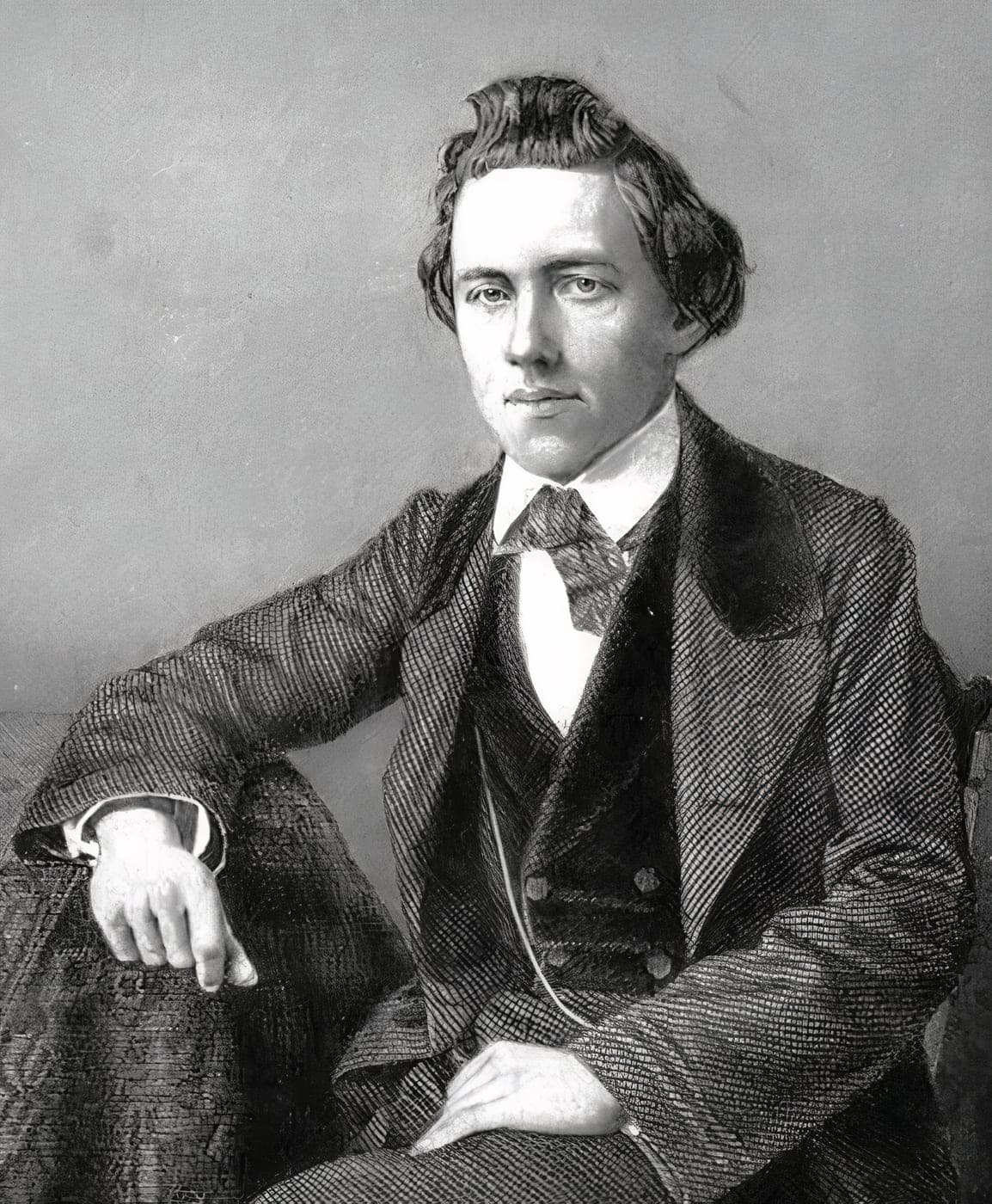
Photo by ناشناس (مالکیت عمومی) · Public domain · Wikimedia Commons
The boy who learned chess by watching
Paul Morphy was born in 1837 in New Orleans, the lively port city of Louisiana. His family was one of the well-off, respected families of the city. His father, Alonzo Morphy, was a lawyer and later a judge on the state supreme court, and his mother was a musician. So Paul grew up in a house where books, music and serious conversation were part of everyday life.
The funny thing is that nobody taught him chess. Little Paul would sit beside his father and his uncle Ernest in the evenings and watch them play. The story goes that one day, when his father and uncle had agreed a draw and wandered off to other things, Paul, still a schoolboy, told his mother that uncle Ernest could have won if they had kept playing, and even showed her the move. When his father came back and saw the boy was right, he finally realized what was growing in their house.
From then on his father took Paul's chess seriously, but he set one rule: school and studies come first. Paul never saw chess as a job. To him it was a wonderful pastime and a sign of an educated person, and that attitude would later shape his strange fate.
At nine he beat a European master
Around 1846 a Hungarian chess master named Johann Löwenthal came to New Orleans. Löwenthal was a well-known figure in European chess at the time, and he was on a long tour of America. The city's chess club asked him to play a match against the nine-year-old everybody was talking about.
The result was unbelievable to many: little Paul won two games and drew one. Löwenthal was thoroughly shaken by the boy's talent and praised him warmly; and Morphy, for his part, kept that famous name in his memory from that very day, long before he met him again in Europe.
After that, the chess players of New Orleans went after Morphy one by one, and none of them could stay with him. By the time he was twelve or thirteen, the local masters were losing to him, and he had to wait for a visitor to come to town just to have a proper opponent.
Studies first, chess second
Despite this talent, Morphy never left school. He studied at Spring Hill College in Alabama and graduated at about eighteen with brilliant marks and a command of several languages. Then he turned to law, his father's profession, and at twenty he received his law degree from the University of Louisiana.
The problem was that the law of the time did not allow anyone under 21 to practice. So Morphy held a full degree but could not work for a year or so. That empty stretch gave him the chance to take chess more seriously, because he simply had nothing better to do.
This is an important point: Morphy never wanted to be a professional chess player. Like many educated people of his era, he saw chess as a gentlemanly game and not a way of making money. That single principle helps us understand why his story was so short and yet so glorious.
The first American Chess Congress and a clean sweep
In 1857 the first national chess congress of the United States was held in New York, a tournament meant to bring together the best players of the country. Morphy, who had just turned twenty, had to be talked into playing. His family was reluctant at first, but in the end they agreed.
The event was a knockout, and Morphy pushed his opponents aside one by one. In the final he met Louis Paulsen, a German-American who was one of the strongest players on the continent and who played a patient, defensive style. Paulsen tried hard to make the games long and tiring, but Morphy did not give in and won by a wide margin.
After this tournament his name spread everywhere. Newspapers wrote that America finally had a truly great chess player. In those days, when chess was still mostly seen as a European game, he was no longer just a local talent; he was the face of a young country that wanted to have something to say in every field.
The trip to Europe: a one-year adventure
In 1858 Morphy set off for Europe at his own expense and with a few letters of invitation. His aim was clear: to meet the best players of the continent on their home ground and ask them whether they were ready. His first stop was England, where chess was full of clubs and masters.
There he met Löwenthal again, the same master who had once played the boy in New Orleans. This time they played a longer match and Morphy won comfortably, with 9 wins, 3 losses and 2 draws. Then he went to Paris and beat another major player, Daniel Harrwitz.
Right in the middle of all this, Howard Staunton, who until then had been regarded as the best player in Europe, pulled out of a match with Morphy, giving different reasons: lack of time, illness, writing work. Many people then, and still today, think Staunton was afraid. In the end Morphy never managed to sit down opposite him.
The Staunton affair: the match that never happened
If we had to call one part of Morphy's trip bitter, it would be the story of Howard Staunton. Back then Staunton was the best player in England and the editor of a famous chess column. Everyone thought a Morphy–Staunton match would be the biggest chess event of the century. From the moment he reached London, Morphy pursued exactly that match, and clubs and fans pushed for it to happen.
But every time a date was fixed, a new problem appeared. Once Staunton said he had to prepare for another tournament, once he said he was unwell, once that he was swamped with his writing and publishing work. Morphy, who had only a few months in Europe and a limited travel budget, slowly grew tired and had to carry on without Staunton.
To this day historians disagree about it. Some think Staunton was truly afraid; others say he simply did not want to give up his position as England's best player and refused to take the risk. Whatever the truth, the match never happened, and it became one of the most fascinating "what ifs" in the history of chess.
The Anderssen match and the Opera Game
The high point of the trip was the match with Adolf Anderssen, the German master who had been seen as Europe's strongest player since 1851 and who played a brilliant, attacking style. The match was held in Paris and Morphy won it with seven wins, two losses and two draws. Afterwards Anderssen spoke with respect about Morphy's strength and accepted that this young American was ahead of all of them.
But the most famous game of the trip was not an official match at all. One night at the Paris Opera, while Morphy was watching "Norma", the Duke of Brunswick and Count Isouard asked him to play a game. Morphy, with White, in the middle of the performance and in that same box, finished the game with a beautiful sacrifice and a precise checkmate.
Today it is called the "Opera Game" and almost every chess teacher shows it to students. It is not famous for being complicated; it is famous for being simple. Every move has a clear purpose: bring your pieces out fast, take the center, make your king safe, and when your opponent falls behind, strike.
A player ahead of his time
To understand why Morphy matters so much, we need to remember what chess looked like then. Most players chased quick attacks and flashy sacrifices without paying attention to basic preparation. Morphy, on the contrary, applied new principles that later became the foundation of modern chess.
First principle: develop your pieces faster than your opponent. Before attacking, Morphy brought his knights and bishops to good squares and made his king safe by castling. Second: take the center and use it to attack. Third: when your opponent has not made his king safe, press him with an attack before he has time to defend.
These principles look obvious to us today and every coach starts beginners with them. But Morphy used them earlier than everyone else, half consciously and half by feel; and that is why later champions such as Capablanca and Fischer always spoke of him with respect.
Blindfold chess and unmatched exhibitions
Besides official games, Morphy was famous for displays of skill. One of the best known was a blindfold simultaneous display: without seeing the boards, he played eight strong Parisian players at the same time. That night at the Café de la Régence, the center of Paris chess, he won six games and drew two.
Eight games without seeing any of them means holding eight boards with all their pieces in your head, for several hours. Even today that is hard for great players. But in those days, when books and training tools were scarce, such a performance seemed almost a miracle.
These displays made Morphy seen not only as a strong player but as a cultural phenomenon. People in Paris, London and later New York threw celebrations for him, gave him medals, cups and gifts, and newspapers spoke of him like a movie star, in an age before there were any movies.
A hero's return and an unexpected goodbye
In 1859 Morphy sailed back to America and was welcomed in New York and Boston like a national hero. He was given a silver chess set and invited to great ceremonies. He was now regarded not only as the best player in America but as the best in the world, although an official world championship did not yet exist.
But then something strange happened: Morphy announced that he was putting chess aside. He had a clear reason of his own. He saw chess as a pastime and did not want to stay a "professional chess player" for the rest of his life; he wanted to be a lawyer and build an ordinary life. In those years many players asked him for matches and he refused, unless they accepted odd conditions such as giving him the advantage of a pawn and a move.
Unfortunately that was a poor time to start a legal career. The American Civil War was about to begin and the South was in crisis. Morphy, whose name was his greatest asset, did not manage to build a solid position as a lawyer. Perhaps people knew him more for his chess than for his law.
Lonely years and a sad evening
After that farewell, Morphy's life slowly grew sadder. A few years after the Civil War his family's finances worsened, and he spent more and more of his time in loneliness and silence. Some sources say he suffered from mental illness; he spoke of fear of being poisoned and had come to distrust some people.
For this reason he spent most of his time at home, sometimes wandering the streets of New Orleans talking to himself. Yet it is interesting that even in those years chess players sometimes visited him, and he still remembered his old games and talked about the moves precisely.
In 1884, at 47, Morphy was found dead in his bath after a hot and heavy day. Doctors recorded the cause as a brain hemorrhage caused by the shock of cold water after the heat. The news of his death was printed in American and European papers, and he was remembered with respect.
Morphy in the eyes of those who came after
One of the most interesting things about Morphy is that even after all these years, the great champions of chess still talk about him. Wilhelm Steinitz, the first official world champion, who had a completely different style and believed in patient positional play, respected Morphy despite the difference and later explained, as an organized theory, the principles Morphy had applied by instinct.
Capablanca, himself a young prodigy, said that as a child he got to know Morphy's games and enjoyed their simplicity and clarity. And later Fischer wrote one of his most debated articles about the greatest players in history and included Morphy in it. It does not matter exactly what rank he gave him; what matters is that different generations, with different styles, all respected him.
Even today, when professional players review old games with powerful engines, Morphy's games are still admired for their level of accuracy. Of course, engines also find small mistakes in them, but what matters is how early he understood that a move made with a purpose is worth more than one that is merely "pretty".
Five simple lessons from Morphy for new players
If you want to learn something from Morphy that will help your games tomorrow, there are five simple lessons. First: bring your pieces out in the first ten moves. Every time you move the same piece twice or push an aimless pawn, you are wasting time. Morphy brought his knights and bishops into play first and only then thought about what came next.
Second: make your king safe early. Castling is not just a technical move; it takes the king away from the middle and brings the rook into the game. Third: take the center with pawns and pieces. Fourth: before every move ask what threat your opponent has, which is the same habit we call "board vision" in Shatrino's skill map. And fifth: when your opponent has not made his king safe, hurry with your attack, because the chance disappears quickly.
These five points may sound simple, but most club games are decided by exactly these principles. If you play a game against the computer today and then press "Analyze game", you will probably see that most of your mistakes fell into one of these five. That means that over a gap of more than a hundred and sixty years, Morphy's lessons still point exactly at the places where we struggle.
Why does Morphy's name still live?
If we only look at the results table, Morphy played serious chess for just a few years. But his impact is deeper than many others', because he showed that chess is not just memorizing beautiful sacrifices; it is a game with clear principles. Development, the center and king safety: the three keys that coaches still teach us first of all.
Many later champions, including Capablanca and Fischer, spoke of him as one of the great geniuses in the history of chess. Fischer, who never praised anyone easily, also counted Morphy among the greatest players of all time.
So if you have just started chess, do one simple thing: set up the Opera Game on a board and go through it move by move. You will see that a twenty-year-old genius, without any of today's tools and just by understanding a few simple principles, created a masterpiece. And these are exactly the things you learn in Shatrino's lessons, only this time with an engine and a coach beside you.