

Mikhail Tal
Mikhail Tal · Latvia (former Soviet Union) · 1936
The Magician from Riga; the champion who rattled opponents with wild, unpredictable sacrifices.
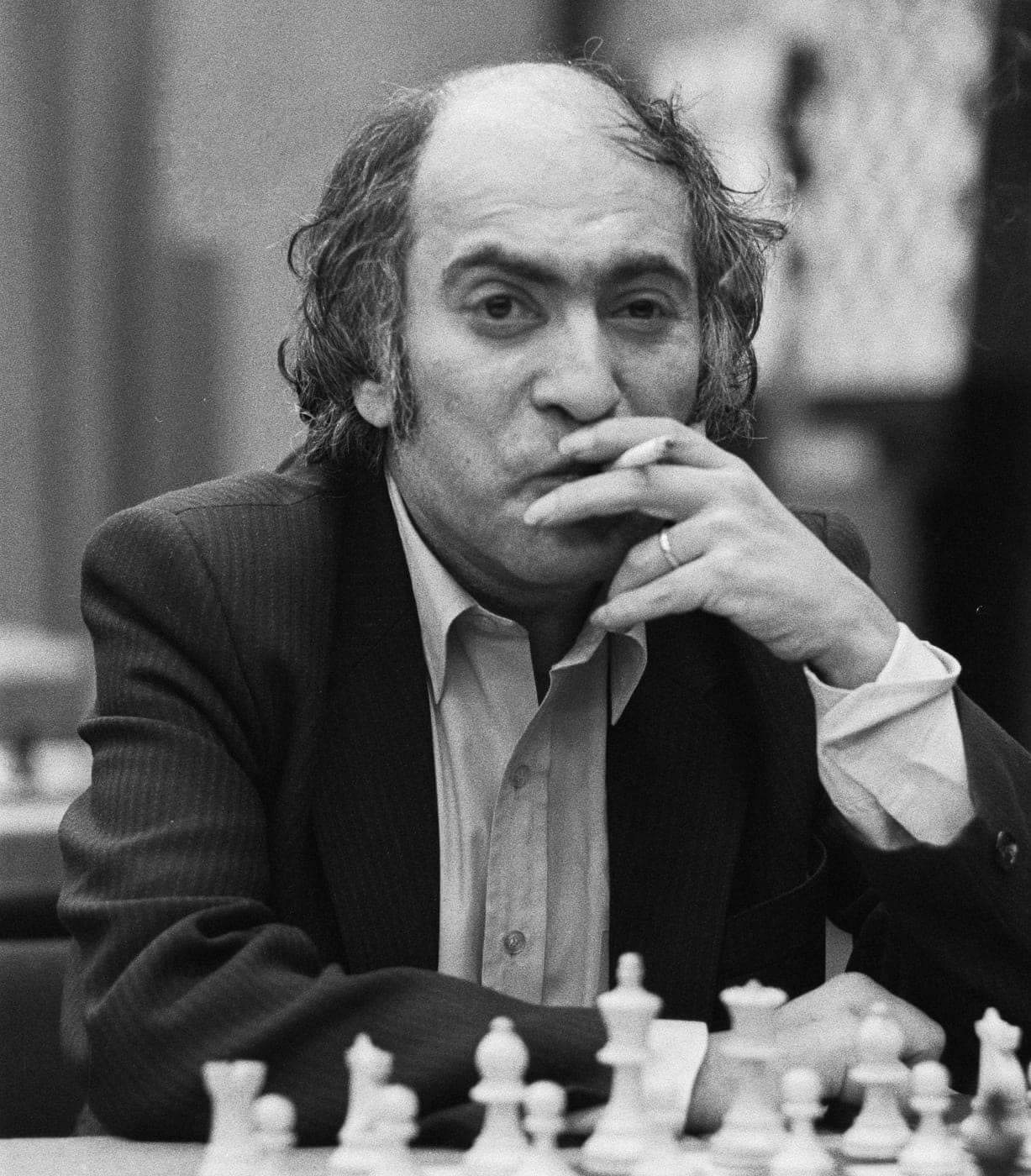
Photo by Rob C. Croes / Anefo · CC BY-SA 3.0 NL · Wikimedia Commons
The unusual childhood of a precocious genius
Mikhail Tal was born in 1936 in Riga, the capital of Latvia (then part of the Soviet Union). Tal was a completely unusual child; at 5 he could read and write, and at 7 he started school but went straight to third grade because his level was far above kids his age. His amazing photographic memory let him memorize whole books after reading them just once.
Tal learned chess at 10 from his father, a doctor. Unlike many champions who had a direct path to professional chess, Tal first wanted to study literature and even studied Russian literature at the University of Riga; but in the end his love of chess was stronger than everything.
Interestingly, unlike many of his contemporaries who focused only on chess, Tal also had a deep interest in literature, poetry and music; he could talk for hours about Russian writers, and that broad knowledge and creative mind was probably one of the main reasons for his unmatched imagination and creativity at the chessboard.
The youngest world champion up to that time
In 1960, at only 23, Tal played Mikhail Botvinnik, the experienced and legendary world champion of the time. Everyone thought Botvinnik's experience would have the last word, but Tal, with his strange and dangerous style, completely surprised Botvinnik, won decisively and became the youngest world champion up to that time; a record later broken only by Garry Kasparov.
But there was a strange rule in that era: the defeated champion (Botvinnik) had the right to request an immediate rematch. Botvinnik, who over that one year had studied Tal's strange style with great care and prepared, managed to take the crown back in 1961. After that Tal was never able to return to a world championship match, but his reputation as one of the greatest geniuses in chess history was never forgotten.
One main reason for Tal's loss in the rematch was his physical condition; right before and during the rematch Tal was battling a severe relapse of his kidney illness and even had to play part of the match in severe physical pain. Still, Tal never used this as an excuse and always humbly accepted Botvinnik's superiority in that particular rematch.
A magician who challenged logic with sacrifices
Tal's playing style is unmatched in chess history. He loved sacrificing pieces, even when today's computers (which didn't exist then) show that many of those sacrifices weren't completely sound in theory. But here's the thing: Tal wasn't after being "correct", he was after "complicating" the game. His philosophy was that if you make a position so complicated that no human can calculate everything, the opponent will sooner or later make a mistake; and then Tal was ready to get the maximum out of that mistake.
Tal himself has a famous line: "There are two kinds of sacrifices: correct ones, and mine." That humorous line sums up his personality and style exactly; a man who, with incredible courage and confidence, was ready to give up pieces just to trap his opponent in a dangerous, unpredictable game.
Today's analysts who check Tal's games with powerful chess engines have reached an interesting conclusion: many of Tal's "crazy" sacrifices were in fact more accurate than his contemporaries thought. That means Tal, without modern analysis tools, was doing calculations in his head that are admirable even today.
A life full of pain and illness
Behind that brilliant personality and chess genius, Tal battled serious kidney illness all his life. He endured dozens of operations and many times, even in hospital, kept playing chess or writing analysis. Despite these exhausting illnesses, Tal never lost his witty, cheerful spirit and always endured even the hardest circumstances with a smile and humor.
He was also a heavy smoker and fond of drink, habits that probably made his physical condition worse. Tal died in 1992 at only 55 because of those same physical problems; far earlier than he should have, but his legacy in the chess world never faded.
Despite those exhausting illnesses, Tal never completely lost the quality of his play; even late in his life he sometimes showed brilliant games in big tournaments against the youngest generation of players in the world. One memorable moment was Tal beating Garry Kasparov (then world champion) in a blitz tournament; an event that showed that even late in life and in the worst physical condition, Tal's genius was still alive.
The most beloved champion among his rivals
An interesting thing about Tal is that even his fiercest rivals loved him. Unlike many other champions who had cold, competitive relationships with their opponents, Tal had close, warm friendships with everyone, including his toughest rivals. His funny, humble, lovable personality made everyone, fans and rivals alike, love having him at tournaments; a rare trait in the competitive and sometimes stiff world of professional chess.
Even Botvinnik, who took the world championship crown back from Tal, always spoke with great respect about Tal's genius. Those warm relations are one reason Tal, despite being world champion for only a year, is still regarded as one of the most beloved and lovable figures in all of chess history; a popularity greater than that of many champions who held the crown for more years.
The lasting legacy of a unique style
Tal's legacy isn't limited to his games; later generations of attacking players, including players like Alexei Shirov and even part of Hikaru Nakamura's style, were inspired directly or indirectly by Tal's tactical boldness. His birthplace, Riga, still hosts the Tal Memorial tournaments every year with the world's best players; tournaments held in honor of this unique genius.
The books Tal wrote about his life and games, especially the famous "The Life and Games of Mikhail Tal", are still among the most popular and best-selling books in chess history; because Tal was not only a superb player but also a talented storyteller who could explain the intricacies of chess with humor and warmth.
Tal also worked for years as editor of a famous chess magazine in Latvia and trained a new generation of chess analysts and writers. Even during his hard illnesses and repeated hospital stays, Tal never gave up writing and analyzing games; as if chess and words were the only things that could make him forget his physical pain for a few hours.
Marriages, poetry and a life of ups and downs
Tal's personal life was as full of ups and downs as his playing style; he married several times and his relationships were usually full of intense, sometimes stormy emotion, just like his games on the board. Tal loved poetry and sometimes wrote it himself; that deep artistic sense is probably one reason his games look more like works of art than dry mathematical calculation.
Tal's close friends always recall his endless sense of humor; even in the hardest moments of illness, Tal tried to lighten the mood with jokes. That mix of genius, pain and joy has made Tal one of the most human and lovable figures in chess history; someone whose personality even generations who never saw him play still come to love.
Why should we study Tal's games?
If you love attacking chess and watching bold, unexpected sacrifices, Mikhail Tal's games are exactly what you're looking for. Even if some of his sacrifices aren't perfect by today's theory, the pleasure of watching them and learning tactical boldness from Tal is unmatched. In Shatrino's Masters' Games section you can replay several of Tal's real games.
Replay Mikhail Tal's real games
In Shatrino's masters' games section, several of Mikhail Tal's real games are available; replay them move by move.
Go to masters' games