

Mikhail Botvinnik
Mikhail Botvinnik · Soviet Union (Russia) · 1911
An electrical engineer with a doctorate who ran chess like a scientific project: a diet plan, practice amid noise, round-the-clock analysis; with that method he became world champion three times and coached Karpov and Kasparov.
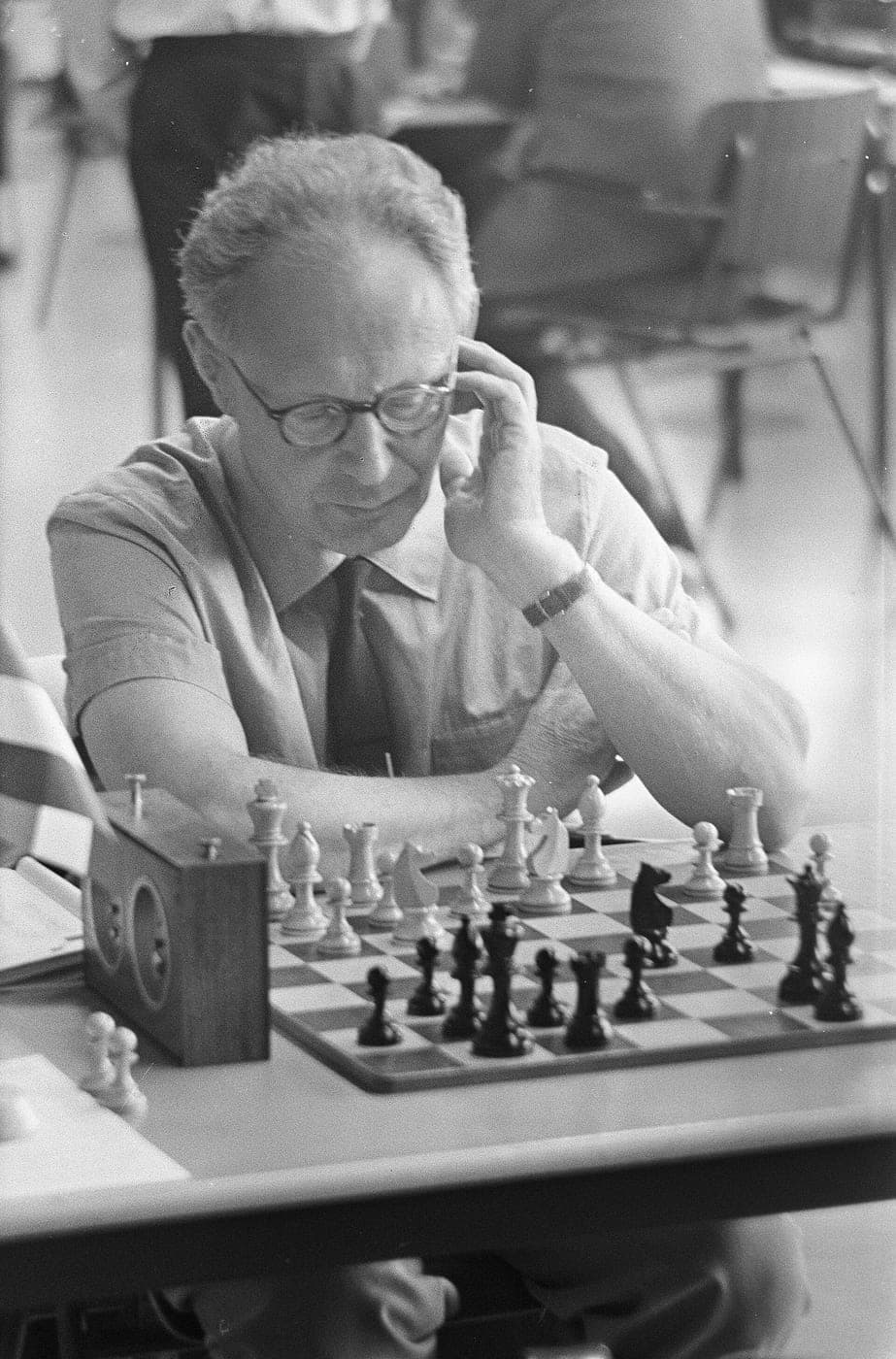
Photo by Jack de Nijs / Anefo (آرشیو ملی هلند) · CC0 · Wikimedia Commons
A boy who started late
Mikhail Botvinnik was born in 1911 in Kuokkala, a small settlement in the Finnish region that was then ruled by tsarist Russia (today it is called Repino and lies near St. Petersburg). His childhood passed in one of the most turbulent periods of Russian history: the World War, the 1917 revolution and the civil war that followed. After these upheavals his family moved to Petrograd, later Leningrad.
Unlike many chess prodigies who start at four or five, Botvinnik learned chess late. Around the age of 12, at school, he picked up the rules. He later said he knew almost nothing about the game then and it was mostly a pastime. But what he had was a big advantage: an analytical mind and a lot of patience for thinking.
In those days chess was just becoming popular in the Soviet Union and the state supported it as a sign of intelligence and the new culture. Botvinnik grew up on exactly the right wave: a time when chess was becoming a national pastime and strong players had classes, tournaments and backing.
At fourteen he beat Capablanca
In 1925 José Raúl Capablanca, the world champion, came to the Soviet Union and gave a simultaneous exhibition in Leningrad, playing dozens of people at once. Botvinnik, 14, was among the opponents that day, and amazingly he managed to win his game.
The story was told many times in later years, because a fourteen-year-old who had been playing chess for just over a year had beaten the world champion. Of course in simultaneous exhibitions champions play quickly and with less care, so such losses are not unusual, but as the start of a career it is a wonderful picture.
Botvinnik later wrote that this game gave him confidence that he could find a place for himself in chess. But he never regarded himself as a "natural genius"; he always said his progress was the result of regular work and careful analysis, not inspiration.
An engineer who also played chess
Unlike most professional players, Botvinnik never used chess as an excuse to leave university. He studied electrical engineering at the Leningrad Polytechnic and graduated in 1934. Later he also earned a doctorate in technical sciences and worked in research institutes on electrical systems and machines.
These two paths, chess and engineering, shared one thing in his mind: solving problems with exact methods. When he had a technical problem he divided it into small parts and studied each part separately. He saw chess the same way: a complex problem to be solved by a scientific method, not just by inspiration.
Interestingly, Botvinnik moved between these two worlds all his life. During the years when he was world champion he worked in the electrical institute by day and analyzed chess at night. For him chess was part of life, not all of it.
Scientific preparation: chess as a project
What set Botvinnik apart from his contemporaries was his way of preparing. Before every important tournament he drew up a detailed plan: exercise, regular sleep, diet, walks and then hours of analysis. He gave the body as much importance as the mind, because he knew a five-hour game needs both.
One of his strangest methods was training under disturbing conditions. He held practice games in crowded, noisy rooms, even full of cigarette smoke, so that he could keep his concentration in any circumstances. That means that before facing any distraction in a real tournament, he had already experienced it.
He also analyzed his own games, wins and losses, with great care and built a file on each opponent: favorite openings, weak points, even behavioral habits. Today every professional does this, but at that time such a systematic approach was almost unprecedented.
The first Soviet grandmaster
Botvinnik became Soviet champion in 1931, when he was only 20. That victory made him one of the country's chess stars. A few years later, in 1935, he was the first to receive the title of "grandmaster" from the Soviet Union. It was more a state honor than an official international title, but it showed how respected he was.
In 1936 at the Nottingham tournament in England, the Western world saw Botvinnik for the first time in a major international event. There he tied for first with Capablanca, former world champion, the same man he had played in the Leningrad exhibition 11 years earlier. The result showed that the young pupil had become an equal.
After this tournament Botvinnik was a national hope. The Soviet government expected a Soviet world champion one day, and Botvinnik was the best candidate.
AVRO 1938 and the game against Capablanca
In 1938 a remarkable tournament called AVRO was held in the Netherlands, with eight of the best players in the world, aimed at choosing a challenger for world champion Alexander Alekhine. Botvinnik finished third, behind Paul Keres and Reuben Fine. That was not enough to become the challenger, but it showed he was among the very top.
One of his games in that tournament became famous: the one against Capablanca. With White, Botvinnik built a long and precise attack that in the end brought down Capablanca, who was unmatched even in defense. Many chess historians consider it one of the best games in history, and it is still analyzed in chess books.
After AVRO a match between Botvinnik and Alekhine for the world title was supposed to take place, but with the noise of the Second World War rising, it never happened. Botvinnik was one of the early, fruitless victims of that era.
War years and rivalry at home
With the start of the Second World War Botvinnik, like other Soviet people, had a hard life. Leningrad was besieged and he was moved with his family to farther cities. In that period he mostly worked as an engineer, helping supply electricity to military industry. Chess became secondary for him, but he never put it down.
In 1941 he took part in a special tournament called the "Absolute Championship of the USSR", where the best of the country played, and he won it, ahead of several other strong masters. The victory showed that despite the gap from big international tournaments, he was still the best Soviet player.
But the problem was that Alekhine, the world champion, was stuck in Europe in wartime conditions and his relations with the Soviet Union were poor. So a match between him and Botvinnik was not possible. Botvinnik had to wait for conditions to change.
1948: the crown that came after Alekhine's death
In 1946 Alekhine suddenly died and the world title was left without an owner. The World Chess Federation (FIDE) decided that instead of a two-man match it would hold a five-man tournament: Botvinnik, Smyslov, Keres, Reshevsky and Max Euwe. It was played in 1948 as a round robin, half in the Netherlands and half in Moscow.
Botvinnik won the tournament with 14 points out of 20, far ahead of Smyslov, who came second, and became world champion. It was not only a personal victory; it was the first time a Soviet player became world champion, and from then on, for several decades, the Soviet Union dominated world chess.
For Botvinnik it was a double event. On one hand his great dream had come true; on the other he now had the heaviest responsibility: representing his country and having to prove at every moment that he deserved the title.
Three reigns
Botvinnik's championship story is like nobody else's. He was world champion three times, and twice he lost the crown and took it back. Between 1951 and 1954 he played two matches, one with David Bronstein and one with Smyslov, and both ended 12–12; under the rules of that time, in a tie the champion kept the title.
In 1957 Smyslov beat him and became champion. But under the "return match" rule Botvinnik played him again a year later and, with careful preparation, took the crown back. After that, in 1960 he lost to Mikhail Tal, the Magician from Riga, and in 1961 took it back again. The rule allowed champions one more chance to win back the title.
In 1963 Tigran Petrosian beat him, but this time the return-match rule had been abolished. Botvinnik could not take the crown back. At 52 he closed a period that had started in 1948: more than fifteen years at the top of world chess.
The match with Tal: a lesson from a younger man
The 1960 match with Mikhail Tal was a strange experience for Botvinnik. Tal was 23 and played a risky style with endless sacrifices, the complete opposite of the exact and orderly Botvinnik. Tal won the match 12.5–8.5 and became champion.
But Botvinnik did not accept the defeat; like a researcher he looked for the cause. He analyzed Tal's games again and again and understood how to keep him in simple, safe positions where Tal's sacrifices no longer worked. In the 1961 rematch he won 13–8 and took the crown back.
This story is one of the loveliest lessons in chess: when you lose, do not look for excuses. Look at the game again and ask why. Botvinnik may not have been as creative as Tal, but he knew how to learn from defeat, and that kept him at the top.
Style and the names he left behind
Botvinnik's style can be summed up as "strategic and deep". He was a master of center control, pawn structure and opening preparation. His games usually looked "scientific": every move had a purpose and every position a plan. That is why some called him the "professor of chess".
Two names remain from him in the openings. The "Botvinnik System" in the English Opening has a structure with pawns on c4 and e4 and a bishop on g2. And the "Botvinnik Variation" in the Semi-Slav Defense is a sharp, tactical line that is still seen in major tournaments. Some of today's strongest players still play these lines.
He also loved theory. He wrote many articles and books and analyzed his own games in detail. Later generations learned from these analyses because he explained, for the first time, "why" a move was chosen, not just "which move".
A scientist and a pioneer of artificial intelligence
One of the most interesting parts of Botvinnik's life was his interest in building a chess computer program. From the 1960s he started working on a program called "Pioneer", meant to think like a human: instead of examining millions of moves, it would look at only a few important ones and build a long-term plan for each position.
At that time most programmers were chasing computing power and, to play, would measure everything. But Botvinnik believed a real program should use "planning" like a human master. The program never reached a high level and today's engines went another way, but his ideas are still discussed in artificial intelligence research.
He kept working on this project until his final years. He said that if he could teach a program to think like a human, he could apply the method to industrial and economic problems too. So he was still an engineer and scientist, and for him chess was just a laboratory for understanding thinking.
The Botvinnik school: coach of champions
Perhaps Botvinnik's biggest impact on chess was not his games but his students. In 1963 he founded a chess school for gifted children in Moscow and worked to train the next generation. One of his first students was Anatoly Karpov, who was 12 then and later became world champion.
Ten years later, in 1973, Garry Kasparov, 10, whose original surname was Weinstein, appeared at the same school. From the very first session Botvinnik noticed the boy's extraordinary talent. Kasparov always spoke of Botvinnik as his teacher, although their relationship later became tense.
That means two of the greatest champions in chess history, generations later, grew up with methods Botvinnik had founded: scientific preparation, deep analysis and strict discipline. That is why he is called the "patriarch of the Soviet chess school".
A strict personality and the final years
Botvinnik was not an easy man. He was strict, orderly and sometimes severe. He did not want to befriend his rivals and often kept his distance from other players. Some saw him as cold and unemotional, but his fans said it was just his way of concentrating.
After the Leiden tournament in the Netherlands in 1970 he gave up official play and focused more on teaching and his computer project. He spent the rest of his life researching, writing and working with students, and stayed active until his last years. Even in his seventies and eighties, when young players came to ask his opinion, he answered carefully.
Botvinnik died on May 5, 1995 in Moscow, at the age of 83. He is regarded as "one of the architects of modern chess", the man who showed that chess can be at once a science, an art and a serious sport.
Lessons from Botvinnik for ordinary players
First: analyze every game afterwards. Botvinnik studied his lost games more than his wins. In Shatrino the "Analyze game" button does just that for you: it shows your mistakes and turns them into practice for later review.
Second: have a plan. Good play does not come only from talent; it comes from good habits. Solve puzzles for ten to twenty minutes a day, read a lesson and play one game with analysis. The result of a few months of this beats years of unplanned play. Third: work on your weaknesses. Botvinnik had a plan for each of his. The weakness map on your Shatrino profile shows you exactly this.
Fourth: learn from defeat. After losing to Tal, Botvinnik did not despair; he found the reason and took the crown back. Fifth: be patient. Chess is a long road and he himself started at 12 and took until about 36 to become world champion. If you have just started and still make mistakes, do not worry at all; the greatest started right here.
Why does Botvinnik still matter?
If we had to say one sentence about Botvinnik, it could be this: he turned chess from a spontaneous art into a scientific discipline. Before him most players relied on inspiration and talent. After him exact preparation, analysis and planning became standard.
Today when a professional prepares with an engine and a database, he is unconsciously walking Botvinnik's road. When Shatrino finds your mistakes and gives you puzzles for your weaknesses, it follows the same philosophy of "scientific improvement" that Botvinnik founded.
So if you are looking for a model of progress, look at Botvinnik: not a supernatural genius but an orderly, determined man who reached the highest rank through the right work. And that means anyone with the will can grow in chess.