

Magnus Carlsen
Magnus Carlsen · Norway · 1990
The Norwegian boy who rose from his bedroom to the world championship crown and is now called the human chess engine.
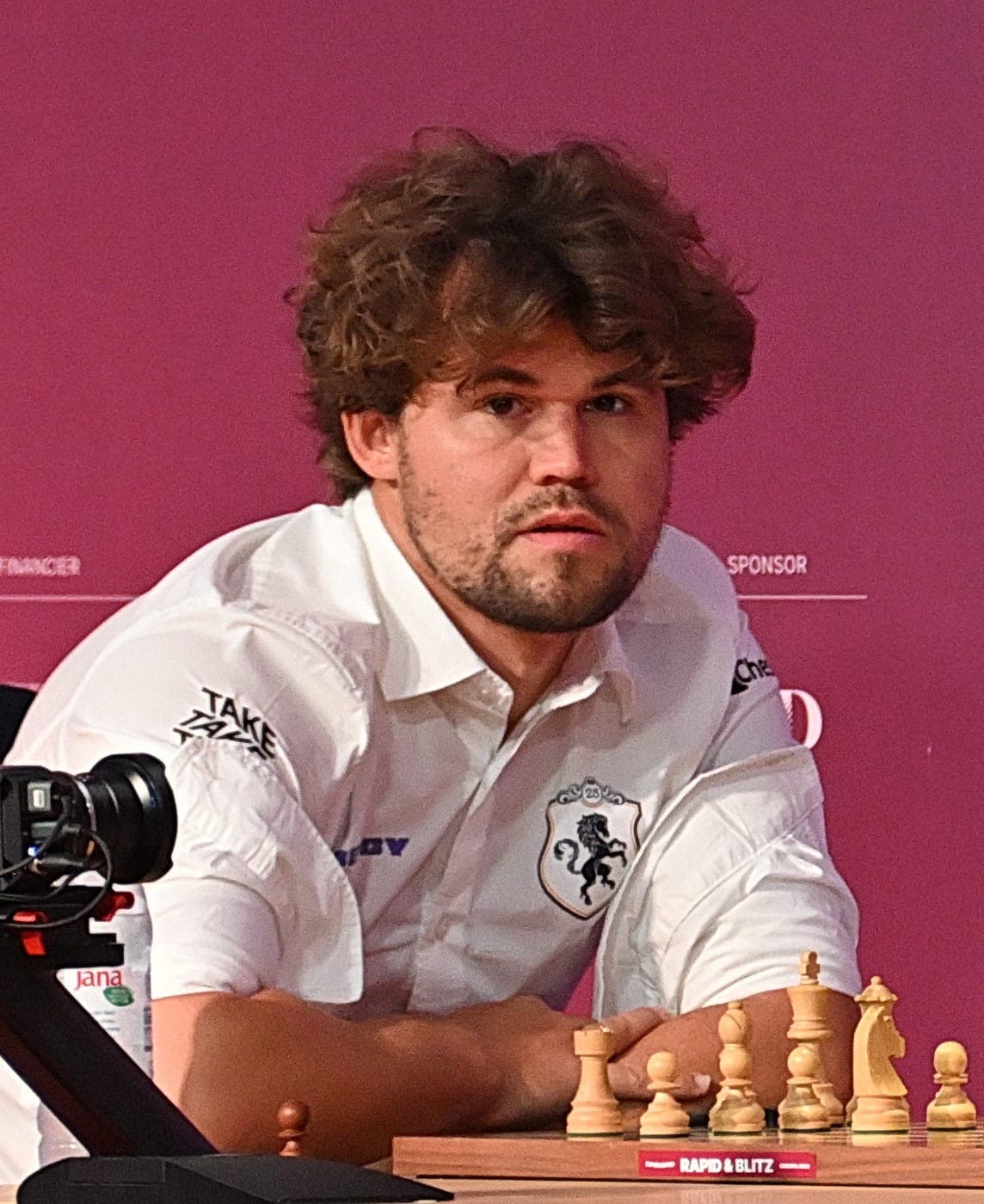
Photo by Miroslav.vajdic · CC BY 4.0 · Wikimedia Commons
A boy who loved puzzles, not just chess
If we tell Magnus Carlsen's story from the very beginning, we have to go to a simple house in Tønsberg, Norway, in 1990. His father Henrik was an engineer who loved chess himself but was no champion; he simply wanted his children to grow up with great thinking games. From early childhood Magnus had an unusual gift: an incredible memory for details. Before he had even learned chess, he could recite the capitals of every country in the world, their populations and their flags from memory. That power of concentration and memory later became his main weapon at the chessboard.
Interestingly, Magnus showed little interest in chess at first. His father tried several times to teach him the rules, but Magnus was bored and preferred playing with Lego or solving hard puzzles. What finally got him hooked was competing with his older sister; when he saw her playing chess and learning, he couldn't stay behind. From there a fire was lit that never went out again.
Another interesting detail is that the Carlsens were not an ordinary family at all. Henrik Carlsen loved travel, and more than once he took the whole family, including Magnus and his three sisters, out of school to spend months touring Europe in a caravan. That unconventional, free life taught Magnus from childhood to think independently and escape the usual molds, a trait that is clearly visible later in his playing style.
From an ordinary kid to one of the youngest grandmasters in history
Magnus's progress in chess was so fast that even great coaches were stunned. He started seriously at 8, and just four years later, at 12, he earned the International Master (IM) title. But the real turning point was 2004, when in a simultaneous exhibition against Garry Kasparov, one of the greatest chess players in history, he managed to draw. Magnus was only 13 then. That same year, getting past the strict requirements of the world chess federation, he was officially recognized as a Grandmaster, one of the youngest ever to reach the title at that time.
The Norwegian media soon gave him the nickname "the Mozart of chess", because just as Mozart understood music like an adult from childhood, Magnus seemed to see the chessboard with an understanding deeper than his age. But what set Magnus apart from many other prodigies was that he didn't only know memorized theory; he felt chess.
In those early years Magnus played in several tough events such as the European and World Youth Championships and was always among the best, but he had not yet become the absolute champion. Some thought his early talent might not be enough and that they should wait for another prodigy. But Magnus, at a speed that surprised everyone, climbed several steps higher every year, to the point that by 15 his rating was above that of many veteran European grandmasters.
Reaching the summit: the 2013 world championship
Between 2004 and 2013, Magnus Carlsen pulled himself up step by step. In 2010, at 19, he became the youngest player in history to reach world number one, a feat that only Kasparov and Karpov had experienced before. But reaching number one is one thing, and becoming world champion is another.
In 2013 Magnus won the Candidates tournament and earned the right to play Viswanathan Anand, the reigning world champion and one of India's greatest chess players. The match was held in Chennai, India, so Magnus had to fight in his opponent's home. Many thought the psychological pressure would make it hard, but Magnus, calm and unbothered, advanced game by game and finally beat Anand decisively, 6.5 to 3.5, to become world champion for the first time. He was only 22.
What made that match special was that Magnus showed you don't need to win every game to become champion; it's enough never to show weakness. In many games of that match he held completely equal positions with great patience until Anand, who was under more psychological pressure, made a mistake. That pattern, endless patience and constant pressure, became Magnus's signature in all his later events.
A reign that lasted for years
Many thought this championship was a passing event, but Magnus showed it was only the beginning. In 2014 he played Anand again and won even more convincingly. In 2016 he played Russia's Sergey Karjakin, a match that was very close in the classical games and was finally decided in the rapid tiebreak, which Magnus won.
In 2018 his challenger was America's Fabiano Caruana, perhaps Magnus's toughest fight up to then. Can you believe that all 12 classical games of that match were drawn? Neither could beat the other. Many critics questioned the match and said top-level classical chess was being played too "safely" and without risk; but when they reached the rapid tiebreak everyone understood why Magnus had been so unbothered about drawing the previous twelve games. In the end, as always, Magnus showed in the rapid portion that he is a step above in fast games and beat Caruana decisively, 3 to 0.
In 2021 he also played Russia's Ian Nepomniachtchi. Game six of that match is one of the most memorable in world championship history: a historic, long game (nearly 136 moves and over seven and a half hours!) that Magnus finally won after Nepomniachtchi's extreme fatigue. That one game crushed Nepomniachtchi's spirit, and Magnus won the rest of the match at full power, paving the way for the continuation of his reign.
A strange decision: stepping away from the world championship crown
In 2022 something happened that shocked the entire chess world. Magnus Carlsen announced that he no longer wanted to take part in the 2023 world championship match and would give up his title. His reason? He said he no longer had the motivation to prepare for a long, tiring 14-game match, and preferred to focus on things that truly excite him, like rapid and blitz games or even Chess960 (chess with a random arrangement of the pieces).
This decision showed that, unlike many champions in history, Magnus isn't after records and titles alone; he's after challenge and enjoyment. In the end, Ian Nepomniachtchi and China's Ding Liren played for the vacated crown and Ding Liren won; but everyone knew the real, unrivaled champion of the chess world was still Magnus Carlsen.
The Niemann affair: when chess became breaking news
In September 2022 one of the strangest events in chess history took place. In an over-the-board event called the Sinquefield Cup, Magnus Carlsen played a young American grandmaster named Hans Niemann and lost. The next day, without any explanation, Magnus withdrew from the rest of the event, something almost unprecedented in professional chess history. That strange silence blew up the whole chess world and even the general media; everyone asked why the world champion had left an event for no stated reason.
A few weeks later Magnus finally hinted indirectly that he thought Niemann had cheated in that game (and possibly in others). That accusation, with no direct evidence, became one of the biggest sports controversies of the year; even Elon Musk tweeted about it! Niemann firmly denied everything and even filed a 100-million-dollar lawsuit against Magnus and Chess.com. The affair showed that Magnus Carlsen's fame had gone beyond the borders of chess and that he is now a well-known figure in popular culture.
Eventually the lawsuit ended in 2023 with an out-of-court settlement, and neither side announced its exact details. But the affair had an interesting effect too: the world chess federation and online platforms had to take anti-cheating rules far more seriously than before and strengthen their cheat detection systems. So even this strange controversy indirectly helped improve the integrity of professional chess competition.
Why is he called the "human engine"?
Magnus's style has something special that astonishes many professional players: he is flexible. Many champions in history had a clear style; Tal, for instance, loved wild attacks and Karpov loved calm, strategic games. But Magnus can play both styles, and even better than the specialists of each. His main strength is his endgames; in places where many players think the game is a draw, Magnus, with incredible patience and precision, wears the opponent down and turns a very small advantage into a win.
Because of this precise, mistake-free style, many call him the "human engine"; his play resembles computer chess engines that don't make mistakes. He himself always says that rather than looking for beautiful, spectacular moves, he looks for the most solid and practical move; that simple philosophy has set him apart from many rivals.
One thing coaches and analysts always praise about Magnus is his ability to wear opponents down psychologically. He usually doesn't rush into tactics; he prefers to prolong the game, build complex, unbalanced positions and gradually force the opponent into hard decisions. Many of his rivals have admitted that against Magnus they feel every move is under a microscope, and that this psychological pressure makes them sooner or later make a small mistake; and Magnus is exactly waiting for that moment.
A record that may stand for years
In 2019 Magnus Carlsen reached a FIDE rating of 2882, the highest classical rating in chess history, a record even Garry Kasparov had not reached. Besides the classical world championship title, he has also been world champion in rapid and blitz several times; that is, he has held the world crown in all three main chess formats (classical, rapid and blitz) at the same time, something no one else in chess history has managed.
Another record that gets less attention is the longest unbeaten run in professional chess history. Between 2018 and 2020, Magnus went 125 classical games in a row without losing, a record that was previously his own and that he broke himself. To understand how big that number is, you should know that at the grandmaster level even world champions usually lose a game every few months; yet for almost two whole years Magnus was impenetrable.
Magnus is also a permanent member of Norway's national team at the Chess Olympiad, and although Norway is a small country without a strong chess tradition like Russia or India, Magnus's presence has made the Norwegian team always one of the respected teams at the Olympiad. That shows that when a player reaches that level of skill, he can single-handedly change the weight of an entire country in a sport.
Life away from the chessboard
Magnus isn't only a chess player. He loves football and is a devoted Real Madrid fan, and he is among the best even in European fantasy football leagues; he once even finished first in the world in Fantasy Premier League. Poker is another of his interests, and he has played in several professional poker events. As a person Magnus is very simple and unpretentious; although he is one of the richest and most famous chess players in history, he always appears in interviews in simple clothes and a down-to-earth manner.
He was also one of the founders of Play Magnus, which was later acquired by Chess.com, which shows that Magnus has played an important role not only in the game but in spreading and popularizing chess in the world. In several televised team competitions called the "Champions Chess Tour" he took part both as a player and as a sponsor and tried to make chess appealing to younger generations and non-professional fans too.
As for his family, Magnus has always been very protective of his privacy and rarely talks about his personal life; but in interviews he has said many times that his biggest supporter has always been his family, especially his father Henrik, who is still next to him at many important events. That simplicity and humility is one reason Magnus is popular even among fans outside chess.
From the chessboard to Twitch and YouTube
One reason Magnus has become even more popular in recent years is his entry into streaming and social media. On Twitch he streams his games live, with hundreds of thousands watching at once, and in a very casual, funny way he talks not only about his moves but also about football, video games and even everyday jokes. That has made Magnus, unlike many earlier champions who seemed distant and serious, give his fans the feeling of an ordinary friend who just happens to be the best chess player in the world.
That active presence online has led a new generation of young people, who might never have been interested in classical chess, to start chess because of Magnus's personality and streams. Many experts say the remarkable popularity of chess in recent years, especially after "The Queen's Gambit" series and the pandemic, owes a lot to energetic figures like Magnus Carlsen and Hikaru Nakamura.
Why should we study Magnus Carlsen's games?
If you want to learn how to turn a small advantage into a decisive win, or see how you can keep playing for a win in seemingly equal positions, Magnus Carlsen's games are the best source for you. His style is so practical and understandable that even average players can learn from it, unlike many complex tactical games that need deep analysis to understand.
Another important point is that Magnus's games usually don't have very strange, surprising openings; instead of memorizing dozens of theoretical moves, he prefers to quickly reach a balanced game and from there build an advantage with his deep understanding of the position. That means that if you're a beginner, his games are easier to follow than many other players', because you won't be drowning in odd and complicated tricks.
In Shatrino's Masters' Games section you can replay several of Magnus Carlsen's real games move by move and see how this Norwegian boy became the greatest chess player of our generation. As you go through each game, try to guess what Magnus will do before seeing his next move; that is exactly the best way to learn from a great master.
Replay Magnus Carlsen's real games
In Shatrino's masters' games section, several of Magnus Carlsen's real games are available; replay them move by move.
Go to masters' games