

Judit Polgár
Judit Polgár · Hungary · 1976
A girl from Budapest whose father set out to prove that geniuses are made, not born; she went on to break Fischer's record, beat world champions and become the strongest woman in chess history.
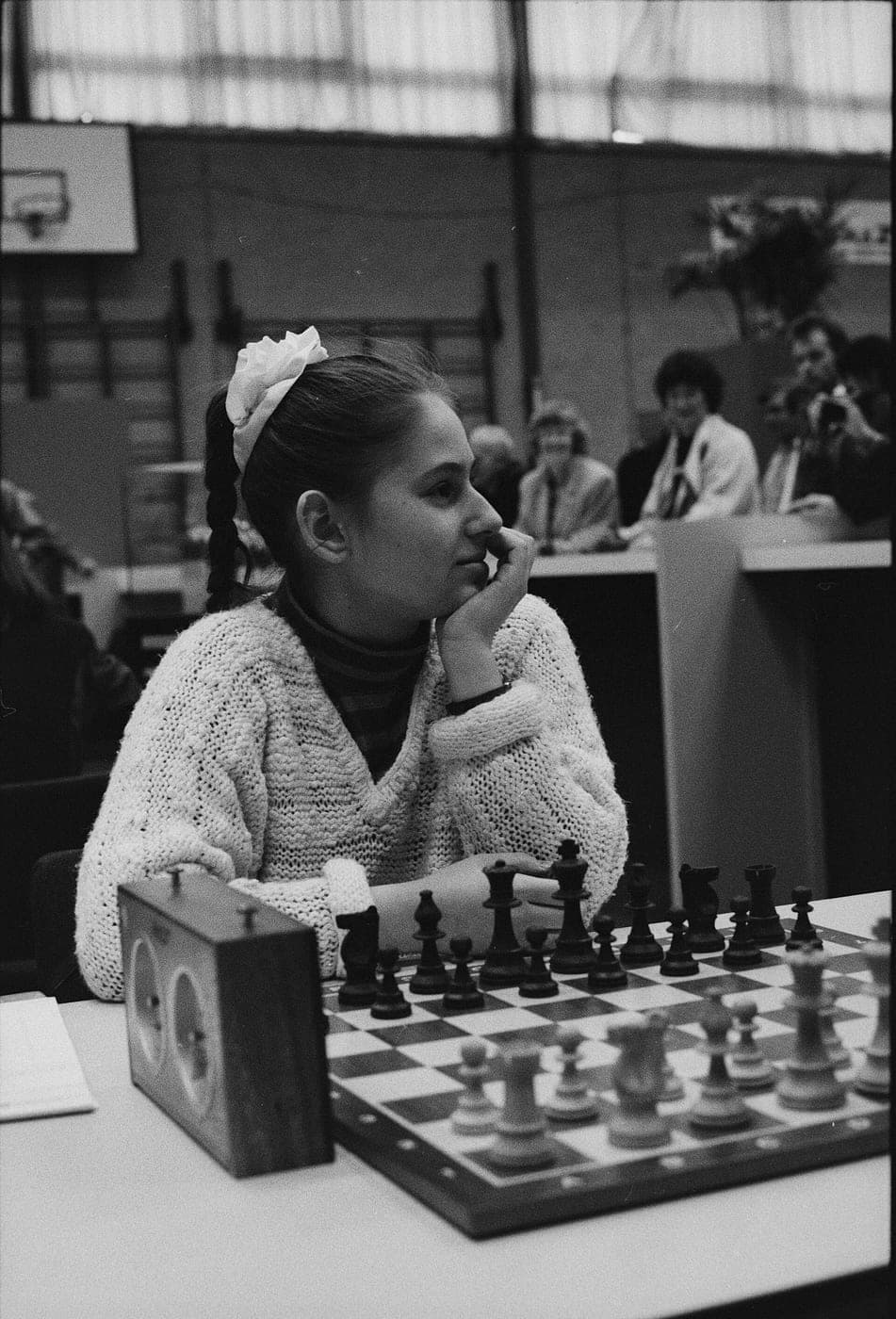
Photo by Fotoburo De Boer (آرشیو شمال هلند) · CC0 · Wikimedia Commons
An experiment that changed a family
Judit Polgár was born in 1976 in Budapest, the capital of Hungary. Her story cannot be told without her father, László Polgár. László was a teacher and psychologist with an unusual belief: "Geniuses are not born, they are made." He believed that any healthy child who is given good, repeated training in one field from an early age can reach the level of genius.
Before he married, László had written about this idea in letters to his future wife, Klára. He wanted to educate his children at home and choose one field in which progress could be measured exactly. Chess was a good choice, because it has ratings and results can be shown in numbers.
The experiment was carried out with three daughters: Zsuzsa (who later called herself Susan), Zsófia and the youngest, Judit. All three learned chess in childhood and all of them reached a very high level in the end. But Judit became the most outstanding of them.
Home school and a room full of books
The Polgár girls did not go to school. Their parents, both teachers, taught them at home. The curriculum included mathematics, foreign languages and science, but a big part of the day went to chess. Judit later said that from the beginning chess felt like play, not work.
In the house there was a special chess room full of books, magazines and handwritten files. László had built a large archive of games and positions before computers and databases became common. That means Judit and her sisters had access from the start to resources that most players their age could not even imagine.
One important point was that the training was not just repetition. Their father knew exactly where each child was and what she needed. When a weakness appeared, they worked on it. This is what today is called "deliberate practice", and Judit experienced it from childhood.
First steps and teenage stardom
Judit started chess around the age of five. A few years later she played in girls' tournaments and then in open ones. There something happened that was strange to many: the little girl was beating adults, even those with years of experience.
In 1988, at the chess Olympiad in Thessaloniki, Greece, the Hungarian women's team, with all three Polgár sisters, won the gold medal. It was a big event, because they had beaten the Soviet team that had dominated the competition for years. Judit was only 12.
Around those years she took first place on the world women's rating list for the first time. A teenage girl was the best woman player in the world. And that was only the beginning, because Judit realized early that playing only women was not enough of a challenge for her.
Fischer's record falls
Until then the youngest person to become a grandmaster had been Bobby Fischer, who got the title at 15 years and 6 months (in 1958), and the record had stood with him for over thirty years. In 1991 Judit Polgár became a grandmaster at 15 years and 4 months and broke Fischer's record.
The achievement made a lot of noise, because Fischer was a chess legend and breaking his record was a symbolic event. Later, even younger records were set, but Judit's name remains forever in chess history as the one who broke Fischer's record.
That same year, 1991, she played in the Hungarian championship, against grown men, and won it. A 15-year-old girl had beaten the men of her own country. From that moment no one could call her "just a female talent".
The decision that surprised everyone: playing the men
Most women chess players of that time played in women's events, because competition was easier and prizes were fair. Judit, encouraged by her father, decided not to take that path. She never played in the Women's World Championship and preferred to compete against the best in the world, women and men alike.
It was a hard decision. Open tournaments were much tougher, and Judit had to play experienced champions who were giants of chess. But that very decision made her level rise very fast, because every game was a real exam, not a comfortable one.
Her older sister Susan took a different road, played in women's competitions and became women's world champion in 1996. Two different paths from one family. But both shone in their own way and proved that women's talent in chess cannot be denied.
Entering the world's top ten
Judit slowly climbed the world rankings. In 2005, at her peak, she had a rating of 2735 and was eighth in the world. That means she had reached the top ten in the world, among men and women together. No woman had reached that level before or has since.
To understand its importance, remember that chess has thousands of professionals and entering the top ten means competing with the best of history. Judit stayed among the best for years. She was the world's top woman player for 25 years in a row.
She played in the world's big tournaments: in the Netherlands, Spain, Hungary and America. Wherever she went, rivals took her seriously, because they knew the girl across the board would take no discounts and give none.
Beating world champions
What wrote Judit's name into history was not only her rating but her results. During her career she beat great players: Anatoly Karpov, Viswanathan Anand, Vladimir Kramnik and Veselin Topalov, all of whom were or became world champions.
But her most famous victory was over Garry Kasparov. In 2002 in Moscow, in a team match between "Russia" and "the Rest of the World", Judit beat Kasparov in a rapid game, the same Kasparov who was then the best player in the world. That day many people understood that Judit was not just a "talented girl".
The game became one of the most famous moments of twenty-first-century chess and, for millions of girls and women, a symbol that there is no glass ceiling.
Style: attack, attack and attack again
Judit's style was like a planned offensive. With White and Black she always played for a win and rarely accepted a draw. Her openings were full of energy, and she built sharp, tactical positions in which exact calculation paid off.
Her calculation ability was famous. In complicated positions she could follow long lines in her head and see threats before her opponent. That is why she had no trouble against patient, defensive players either; she steered the game in a direction where her opponent had to make hard decisions.
Of course this style carried risk. Sometimes a failed attack ended in a loss, but Judit accepted that as part of the game. She said she was not afraid of losing, because every loss is a lesson. And that attitude kept her steady whatever the result.
Becoming a mother and coming back
In 2000 Judit married Gusztáv Font, a Hungarian veterinarian. A few years later, in 2004 and 2006, their two children, Oliver and Hanna, were born. Each time she had a child she stepped away from tournaments for a while and then came back. For most professional athletes such breaks can end a career, but Judit came back stronger each time.
She said that combining motherhood and professional chess is hard but not impossible. On trips she sometimes took the children along, and her days were split between training and parenting. That was another lesson: you can have a full life and still reach the top.
This period showed that Judit's strength did not depend on talent alone; the order and discipline she had learned at home as a child were still with her. Even with two children and a packed schedule she stayed among the best in the world.
Saying goodbye to professional chess
In 2014, after more than twenty-five years at a high level, Judit announced she was retiring from professional chess. She said she wanted to spend her time on other things, especially teaching chess to children. It was a decision that surprised most of her fans.
After retiring she launched the Judit Polgár foundation, which runs a program for teaching chess in schools. The goal is for children to meet chess from an early age, not just as a game but as a tool for learning to think, to be patient and to solve problems.
Judit also appeared at tournaments as a commentator and coach and wrote books. "How I Beat Fischer's Record" is her personal account of her chess life and is good for anyone who wants to know more about her.
Three sisters, three paths
When we talk about Judit we must not forget her two sisters. Susan, the eldest, was in 1991 the first woman to earn the men's grandmaster title by making the required norms, the same road men took. She later became women's world champion, emigrated to America and went on teaching and promoting chess there.
Zsófia, the middle sister, did not make as much noise as her sisters, but her talent was unbelievable. It is well known that at a big tournament in Rome in 1989, when she was only 14, she played so brilliantly that people called it the "Sack of Rome"; she won almost all of her games and pushed aside strong male players one by one. She later earned the International Master title and did more artistic and educational work.
Each of the three sisters chose her own road, but they had a common root: a house where chess was like a mother tongue. When all three children in one family reach a high level in a hard field, you can no longer say it was "luck"; you have to think about method and environment.
An idea that is not only about chess
Judit's educational program after retirement showed that her view of chess went far beyond a game. In schools chess helps children concentrate, think before deciding and predict the results of their actions. These are skills that help in studying, work and life too.
She said chess is also a good way of teaching "responsibility". Whatever move you play, you have to accept its result yourself. You cannot blame anyone else. A child who experiences this early learns to learn from mistakes instead of making excuses.
It is interesting that this is the same philosophy followed in Shatrino's "Analyze game" and "Mistake Practice": a mistake is not a defeat; it is a clue. When you find your mistake and solve it again, you do better in the same position next time.
Her impact on women's chess
Before Judit many people thought women could not play chess at the level of men. Some said the brain was different, others said it was a masculine sport. Judit rejected those assumptions on the chessboard, not with words but with results.
Today many girls around the world play chess and take part in open tournaments. Although the number of women at the top is still small, the road has opened. And when many young girls are asked who inspired them, they name Judit Polgár.
One more important point is that she never wanted to be a "symbol". She just wanted to play chess and be the best. But that very focus on the game itself made her a better role model than any slogan.
A few things we can learn from Judit
First: let yourself play stronger opponents from the start. When Judit played stronger players she improved faster. In Shatrino too you can start with easy bots and slowly move to harder levels; winning is not always learning, but losing to a stronger opponent usually is.
Second: deliberate practice matters more than a lot of practice. Judit did not just play for hours; she found her weaknesses and worked on them. Shatrino's "Weakness map" and "Mistake Practice" do exactly that for you. Third: do not be afraid of losing. Judit attacked and sometimes lost, but that courage is what made her grow.
Fourth: do not accept other people's limits. When everyone said women should play in their own events, Judit went her own way. Fifth: persistence. Judit stayed among the best for twenty-five years, not with a momentary brilliance but with daily work. If you solve puzzles for ten minutes a day, after a few months you will feel the difference.
Why does Judit Polgár matter?
Judit Polgár was not just a strong chess player; she proved an idea: that environment and effort set the ceiling of talent, not gender or age. Her father said geniuses are made, and Judit became the liveliest witness to that claim.
She broke Fischer's record, beat world champions and stayed in the world's top ten for years. And she achieved all of this without running away from the harder road. That is why when we talk about the "greatest of chess", her name should stand beside Capablanca, Fischer and Kasparov.
So if you want a real model to learn from, look at Judit: a girl who, with persistence and deliberate practice, rose from a room full of books in Budapest to the summit of world chess. And if you want to grow too, Shatrino is beside you to build exactly that road.