

Garry Kasparov
Garry Kasparov · Azerbaijan / Russia · 1963
Perhaps the greatest chess player in history; the man who fought both Karpov and a supercomputer.
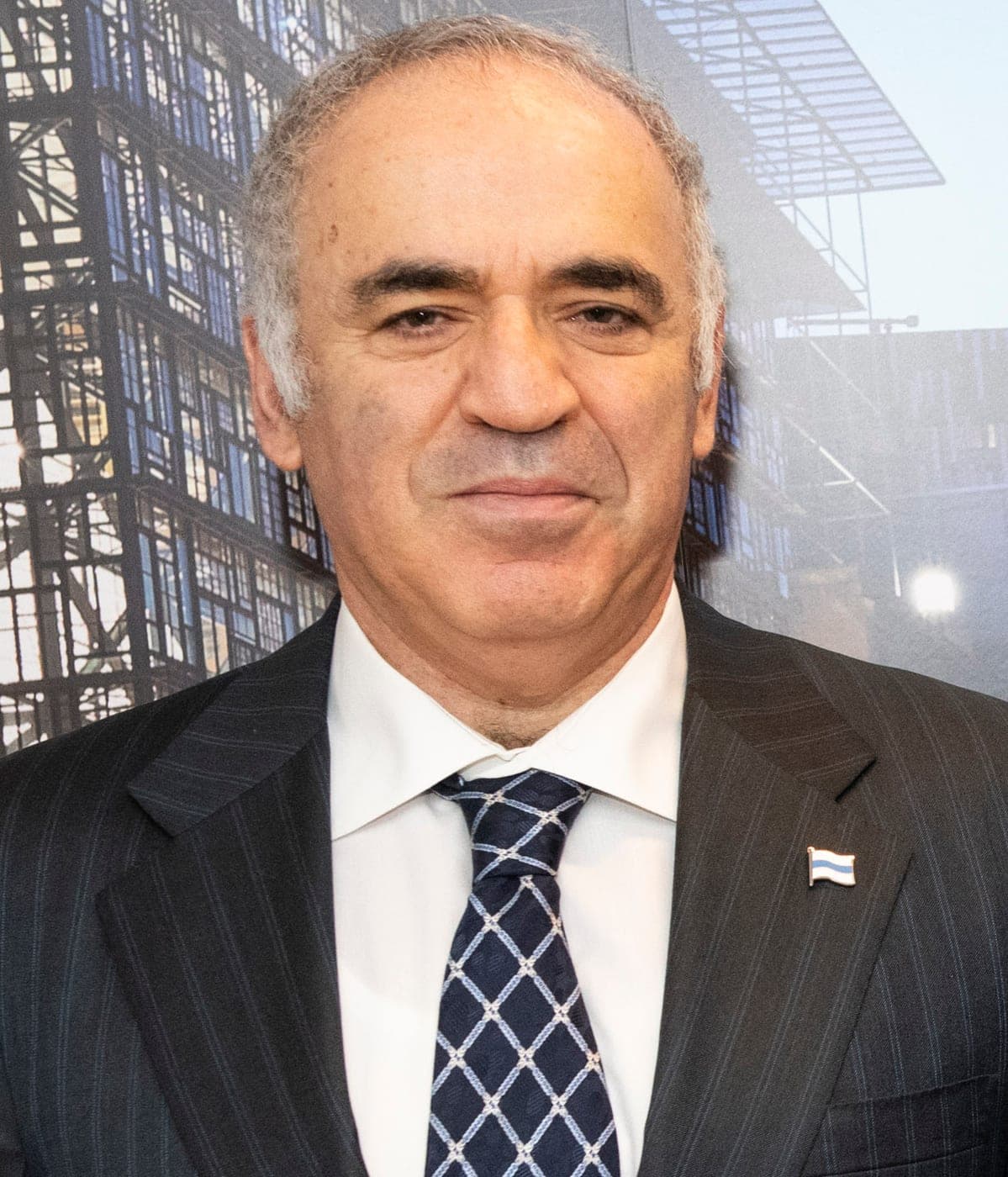
Photo by Lukasz Kobus · CC BY 4.0 · Wikimedia Commons
A boy from Baku with a new name
Garry Kasparov was born in 1963 in Baku, the capital of Azerbaijan (then part of the Soviet Union). His original name was Garry Weinstein, but after his father died when Garry was only 7, he chose his mother's surname, Kasparova, in a masculine form (Kasparov); a decision some say was due to the sensitive political climate toward Jewish names in the Soviet Union at that time.
His mother, Klara, played an incomparable role in raising Garry; she devoted her whole life to her son's progress and was always with him at tournaments. Garry's talent showed very early; at 10 he entered the famous school of Mikhail Botvinnik (one of the legendary former champions), which at that time trained the Soviet Union's best teenage talents.
One famous childhood memory of Kasparov is something that happened when he was 6: one day he happened to see a chess problem in a newspaper his parents were solving and, without anyone telling him anything, told them the right solution. That small moment was the first sign of the extraordinary genius that later shook the whole chess world.
The youngest world champion in history
In 1985, at 22, Kasparov played Anatoly Karpov, the reigning world champion, and won; with that he became the youngest world champion in chess history, a record that still stands. That win ended a long, draining struggle with Karpov that had begun in 1984 (the famous match that was stopped after 48 games with no winner). Over the following years Kasparov defended against Karpov three more times (1986, 1987, 1990) and each time kept his crown.
Kasparov's reign ran from 1985 to 2000; that is 15 years of uninterrupted rule, and even after losing the official title to Kramnik he kept the unofficial world number one spot for years. He also holds the record for the longest time as world number one in the history of FIDE rankings; more than 255 months, almost 21 years!
That record is so big that even Magnus Carlsen, despite years of continuous dominance, hasn't reached it yet. That shows Kasparov was able to keep himself at the highest possible level not just for a short period but over a long span of time against several different generations of rivals; something not repeated like this in any other mind sport.
Man versus machine
Perhaps the most famous moment of Kasparov's career has nothing to do with another human. In 1996 Kasparov played a chess supercomputer called "Deep Blue" built by IBM and won decisively; an outcome that let the world breathe easy that humans were still smarter than machines. But in 1997 IBM prepared a stronger version of Deep Blue and this time, in one of the most historic and controversial events in chess history and even in the history of computer science, the computer managed to beat Kasparov.
That loss was so shocking that Kasparov later claimed that in one of the games IBM had unfairly used human help for the computer; an accusation IBM always rejected and it even refused to release the computer's full data for independent review. The affair became one of the most important cultural symbols of the relationship between humans and artificial intelligence; a subject that today, with the advance of AI, has become even more important.
It's interesting that after that match IBM completely retired Deep Blue and never again allowed Kasparov a rematch; a decision many saw as a sign of the company's fear of a possible defeat and of losing the publicity value of that historic win. The affair became one of the most controversial scientific-sports disputes of the twentieth century and is still a subject of discussion and study for historians of computer science and chess.
Playing style: stormy, dynamic and ruthless
If Karpov was a boa constrictor, Kasparov was exactly his opposite; a wild, aggressive tiger. Kasparov's style was full of energy, initiative and constant pressure. He loved open, complex positions, where he could get the most from his deep calculation and extraordinary preparation (which at the time he did with the help of early personal computers, a revolutionary thing for that era). The combination of that scientific preparation with his fighting, ruthless personality led many experts to regard Kasparov as the strongest chess player of all time.
One special feature of Kasparov was his remarkable emotional intensity at the board; with his fixed stare and body language he put a lot of psychological pressure on his opponents. Many of his rivals later admitted that just sitting across from Kasparov and seeing the focus and intensity of his gaze was enough by itself to make them feel pressure and anxiety; a kind of "psychological warfare" that Kasparov, consciously or unconsciously, always used to his advantage.
From the chessboard to the political arena
In 2005, at the peak of his professional form, Kasparov unexpectedly retired from professional chess. His decision was to devote his life to something just as important to him as chess: democracy and human rights. He became one of the main opponents of Vladimir Putin, the president of Russia, and, despite many dangers and pressures, fought for years in Russia for political reform.
Eventually, because of security pressures, Kasparov had to leave Russia and live as a political activist in exile. Today he is chairman of the Human Rights Foundation and one of the most outspoken, well-known critics of the Russian government worldwide. He has also written several analytical and historical books about chess, including the famous series "My Great Predecessors", which analyzes in depth the playing style of earlier champions.
Kasparov has also written other books on leadership and decision-making in which he uses his chess experience to explain the principles of success in business and politics. Those books show that Kasparov, even outside the chess world, remains a deep and influential thinker whose analyses go beyond a mere intellectual game.
Kasparov's political activities have cost him dearly many times; he was arrested several times at peaceful demonstrations in Russia and once was even beaten by officers while in custody. Even so, Kasparov has never stopped criticizing the Russian government publicly and remains one of the loud, influential voices in human rights on the international stage.
A legacy that is still alive
Today, besides his political activities and writing, Kasparov is also active as an adviser and coach to several generations of young grandmasters, including consulting with the world's elite players to prepare for big events. His deep strategic knowledge, even after twenty years away from professional competition, is still one of the most valuable resources in the chess world.
Most experts and historical rankings place Kasparov, alongside Fischer and Carlsen, among the three main candidates for the title of "greatest chess player of all time". The combination of his long reign, the strategic depth of his games and his broad cultural influence (including the historic match against Deep Blue) has made Kasparov's legacy go beyond simple statistics.
Family life and a many-sided personality
Kasparov has married several times and is the father of several children; he has always stressed that despite his intense political and intellectual activities he tries to leave enough time for his family. His life is a rare combination of a sports champion, a prolific writer, a tireless political activist and a family father; a combination seldom seen in one person.
Kasparov also has a great interest in history and philosophy and in his speeches often uses historical comparisons to explain today's political situation. That intellectual depth, whose roots can be seen in years of deep strategic training and practice in chess, has made Kasparov not just a former sports champion but an influential public thinker on a global level.
Why should we study Kasparov's games?
Kasparov's games are like a storm full of energy and constant pressure; if you want to learn how to put your opponent under pressure from the very start with deep preparation and relentless attack, his games are the best source. In Shatrino's Masters' Games section, several of Kasparov's real games are available.
Replay Garry Kasparov's real games
In Shatrino's masters' games section, several of Garry Kasparov's real games are available; replay them move by move.
Go to masters' games