

Emanuel Lasker
Emanuel Lasker · Germany · 1868
A mathematician and philosopher who was world champion for 27 years, the longest reign in history, and who said he played chess as a fight, not as a formula.
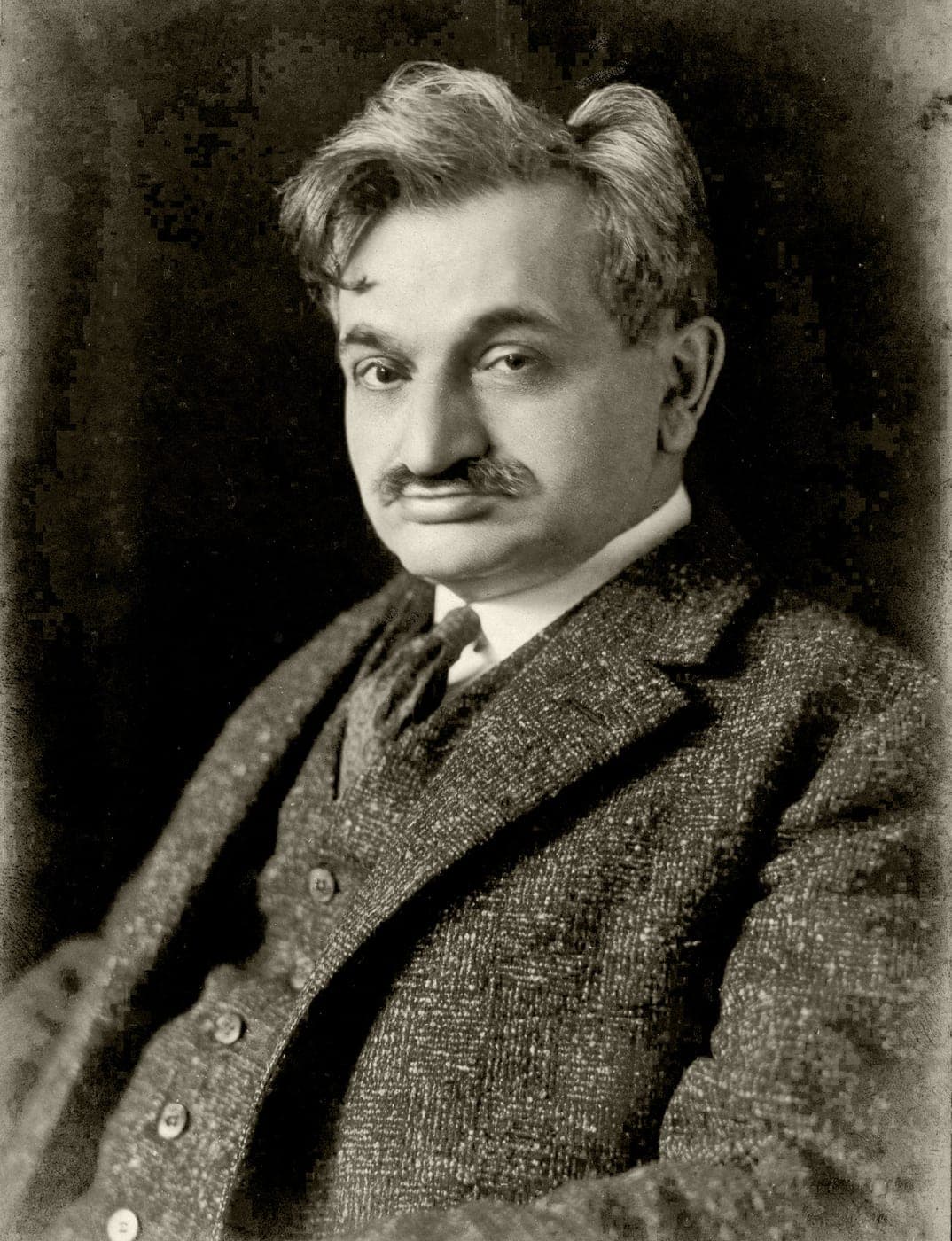
Photo by Trans-Ocean News Service · CC BY 3.0 · Wikimedia Commons
A boy from a small town who loved mathematics
Emanuel Lasker was born in 1868 in the small town of Berlinchen in Prussia (today Barlinek in Poland). His family was Jewish, his father was the cantor of the local synagogue, and money was never plentiful. Emanuel shone in mathematics from childhood, and since his town had no suitable school, they sent him to his older brother Berthold in Berlin.
Berthold was a strong chess player himself and later earned the master title. It was this brother who taught Emanuel the rules, not out of any special love for the game but because it was a simple way to put some money in their pockets: playing chess in the cafés of Berlin for small stakes.
At first Emanuel saw chess only as a sideline to his studies. He wanted to become a mathematician and study at university. But the more he played in the cafés, the more he realized he was better than many people at this game, and slowly the "sideline" turned into something that shaped his life.
From the cafés of Berlin to the tournament world
At twenty Lasker began to play in tournaments. His first results were modest, but he got stronger game by game. In 1889 in Amsterdam he played a game that is still in the books: the one against Johann Bauer. In it Lasker sacrificed two bishops one after the other to strip the enemy king, one of the first famous examples of that combination in serious play, and its name stayed in the books.
After a few years of experience he went to England and again to America and played matches against big names. In England he beat Blackburne and Bird, two famous and long-established masters. By his early twenties everyone knew a new star had appeared in chess, younger and sharper than most.
An interesting point is that being a professional chess player in today's sense did not exist then. Most players lived on simultaneous displays, tournament prizes and stake matches. Lasker earned his living and paid for his studies the same way, while still studying mathematics.
The match with Steinitz: the end of an era
In 1894 the 25-year-old Lasker sat down opposite Wilhelm Steinitz, the 58-year-old world champion who had held the crown since 1886. The match was played in several cities of America and Canada: New York, Philadelphia and Montreal. Steinitz was the great theorist of chess and believed the game had to be won through exact, positional principles.
Lasker saw chess differently. Instead of focusing only on the "best move", he looked at his opponent: where his weaknesses were, what he feared, what kind of position made him uncomfortable. The match ended in Lasker's favor with 10 wins, 5 losses and 4 draws, and the young German became world champion.
Two years later, in 1896–1897, they played a rematch in Moscow and this time Lasker won by a bigger margin, with 10 wins, 2 losses and 5 draws. Steinitz was very upset after these defeats, but Lasker always spoke of him with respect.
Twenty-seven years untouched: the longest reign in history
Lasker was world champion from 1894 to 1921, 27 years, a record nobody has broken to this day. For comparison, Karpov and Kasparov each held the title for roughly ten to fifteen years. What makes it more amazing is that in that period there were very strong rivals such as Tarrasch, Marshall and Schlechter.
Frank Marshall, the American champion, challenged him in 1907 and did not win a single game: Lasker won eight and seven were drawn. Tarrasch, the great German theorist, challenged in 1908 and Lasker won again, with 8 wins, 3 losses and 5 draws. These were just some of the matches in which Lasker defended his title.
The most interesting one was the 1910 match against the Austrian Carl Schlechter. Schlechter was a gentle, peaceful man who even drew won positions. The match had ten games and after nine Schlechter was a point ahead. But in the last game Lasker came back with a stubborn effort, the match ended 5–5 and Lasker kept his title.
A mathematician who also played chess
If you think Lasker was only a chess player, you are wrong. In 1900 he received his doctorate in mathematics from the University of Erlangen and wrote several important papers. One of them, about "ideals" in algebra, was published in 1905, and its result is known today as the Lasker–Noether theorem. Later a great mathematician named Emmy Noether extended these ideas.
So if a modern mathematician works in commutative algebra, he will probably meet the name Lasker, not because of chess but because of mathematics. And strangely, the same man who held the highest chess title for nearly thirty years could not find a stable, long-term university position, perhaps because his fame as a chess player kept him from being taken as seriously as he should have been in the mathematical world.
Besides mathematics Lasker also wrote philosophy. He wrote a book called "Struggle" (1907) and several others about competition and effort in life. He was a friend of Albert Einstein, who later wrote a foreword to his biography. Two geniuses walking the streets of Berlin together and talking about science and life is a nice picture.
Lasker's style: playing the person, not just the pieces
Lasker's style was confusing to many because it had no fixed pattern. Sometimes he attacked, sometimes he waited, sometimes he sacrificed a pawn and sometimes he simply made a quiet trade. The reason was that Lasker saw chess as a "psychological fight": the best move was the one that, at that moment, made his opponent uncomfortable.
That means Lasker would sometimes choose a move that was not theoretically best, but that he knew his opponent disliked. Against an attacking player he built calm positions, and against a patient player he created complications. Some people called it "psychological chess", which even today deserves attention.
One of his sayings sums up his success: he said chess is not only a science or an art but a struggle, and a player who knows only formulas cannot win. And this came from a man who was himself a mathematician.
St. Petersburg 1914: when everyone thought Lasker was finished
In 1914 a great tournament was held in St. Petersburg and the best in the world came: Lasker, Capablanca, Alekhine, Tarrasch and Marshall. Capablanca was then a young, brilliant Cuban star and everyone said he would soon overtake Lasker. In the first stage of the tournament that was really how it looked, and Capablanca took a fairly large lead.
But in the second stage Lasker made an unbelievable comeback. In a key game he had to win, he faced Capablanca, and with the exchange variation of the Ruy Lopez he forced a game on him in which he went wrong. After that Lasker slowly turned the table and finally won the tournament by half a point ahead of Capablanca.
The story usually told about this tournament is that the Russian tsar, Nicholas II, gave the title "grandmaster" to five of the participants, and that the title started to be used from there. Historians disagree about the details, but everyone accepts that this tournament was one of the greatest in history.
The First World War and the loss of his savings
Not long after that tournament the First World War began and the chess world almost went silent. Lasker, a German citizen, was put in a hard position by the pressure of war and the economic crisis. He had put most of his savings into German war bonds, and when Germany lost the war, that money became almost worthless.
Four years of war meant almost four years with little chess. Lasker, now 50, spent much of his time writing, teaching and doing other work. His age and the lack of practice in those years made many think Lasker's era was over, though he, as always, never stepped aside.
To return to chess Lasker needed to find quickly a match that paid well. That is where Capablanca entered as a serious challenger, and after months of negotiation over the conditions the two champions agreed on a match.
Havana 1921: the end of a reign
In 1921 in Havana, the capital of Cuba, Lasker and Capablanca sat down opposite each other. The match was supposed to be 24 games, but in the heavy heat and humidity of Havana, Lasker, who was 52, suffered badly. He said the air was so heavy that he could not collect his thoughts.
After 14 games Capablanca had won four, Lasker had won none and ten were drawn. Lasker abandoned the match, saying that continuing was pointless. Capablanca officially became world champion and a new era began.
At the end of the match Lasker congratulated Capablanca and stepped aside with respect. What is interesting is that he did not lose heart after the defeat; for many champions, losing the title means the end, but for Lasker it was a chapter. He still had several more chapters to write.
A comeback nobody expected
In 1924 a big tournament was held in New York and Lasker, 55, took part. Most people thought he just wanted to play some nostalgic games, but Lasker won the tournament with excellent results, ahead of Capablanca (second) and Alekhine (third), that is, the world champion and the man who would become champion a few years later.
This victory showed that the Havana defeat was more about conditions than strength. And Lasker played as if he were 25. He kept playing well into old age. In 1935 in Moscow, at 66, he finished third and was even ahead of Capablanca. At that age, in a tournament with the best players in the world, such a result is almost unheard of.
This sporting longevity probably came from his view of chess. He did not play for victory or fame; he played for the pleasure of the fight, and that kept his mind young.
Escape from the Nazis and years of exile
When Hitler took power in 1933, Lasker's life was turned upside down. He was Jewish, and his wife Martha was a writer. The Nazis soon confiscated their property and staying in Germany became dangerous. Lasker and Martha left the country, first for England, and then, on an invitation from the Soviet Union, for Moscow.
In Moscow Lasker lived for about two years and was active in scientific and educational work. The Soviet government respected him as a great scientific and chess figure. But with the start of Stalin's purges the atmosphere became dangerous and Lasker decided to leave again.
In 1937 he emigrated to America and settled in New York. He was 68 and not well off. He earned his living by teaching and lecturing. In that same city, on January 11, 1941, he died of a kidney infection at the age of 72. The man who had once ruled the chess world died in exile and illness.
Beyond chess: the game Lasca and the books
Lasker was not only about chess and mathematics. He invented a new board game called "Lasca", played on a 7 by 7 board where pieces can sit on top of each other and form towers. The game never became as popular as chess, but it still has fans.
His "Lasker's Manual of Chess" (1925) was one of the most instructive books of that period, explaining the principles of the game in simple language. Besides that, he played bridge and Go and wrote about them. This man really wanted to understand how "competition" works, both on the board and in life.
Another interesting point is that he also published a magazine for several years, "Lasker's Chess Magazine". If he were alive today, we might call him a "chess influencer", but one with a doctorate in mathematics and a friendship with Einstein!
Two names Lasker left in the openings
If you ever search the opening books for Lasker's name, you will find it in two places. The first is the "Lasker Defense" in the Queen's Gambit. In this line Black starts the trades with a knight move to e4 and exchanges the opponent's pieces one by one so the position becomes compact and safe. It is a simple idea: when you are short of space, trade pieces so you can breathe.
The second is the "Lasker Trap" in the Albin Countergambit, a sharp tactical trap: if White is not careful and falls for it, Black promotes a pawn to a knight with check and wins White's rook. The trap is so famous that everyone who learns the Albin Countergambit reads about it first.
It is interesting that these two names show two sides of Lasker's personality: one calm, logical and defensive; the other sharp, cunning and tactical. This very combination kept him unpredictable through all those years.
Four things we learn from Lasker
First: know your opponent. Lasker did not only look at the board, he also looked at the person across from him. You can try this in Shatrino's games too: if your opponent is an aggressive bot, try to keep the game calm and solid; if it is a defensive bot, build harder positions with pressure and attack.
Second: never give up. Lasker many times drew or even won positions that looked bad by stubborn resistance. Beginners usually stop fighting when they lose a piece, but the opponent can go wrong too. Third: mental and physical health matter. The Havana match showed that even the greatest drop off in bad conditions.
Fourth: learning never ends. Lasker won the New York tournament at 55 and was among the best in the world at 66, because he stayed curious. Chess is a long road and nobody is too great to learn. If after every game you press "Analyze game" and review your mistakes, you are walking exactly this road.
Why does Lasker still matter?
When we look at Lasker we do not see only a champion, we see a whole person: mathematician, writer, philosopher and fighter. He showed that chess can be one part of a rich life, not all of it, and that talent and study can work together.
His 27-year reign is still an unmatched record. Even if later champions played more accurate games and engines find his games full of mistakes, what made him great was his fighting spirit and flexibility: the ability to find, every time, a way to throw his opponent off balance.
So when you start your next game and reach a hard position, remember what Lasker said: chess is a struggle. Until the last move is played, the game is not over. And if you want to know which patterns go wrong in your games, Shatrino's "Analyze game" and "Skill map" are right beside you.