

Anatoly Karpov
Anatoly Karpov · Russia · 1951
A man with a "boa constrictor" style; the champion who fought the longest and hardest battle in chess history against Kasparov.
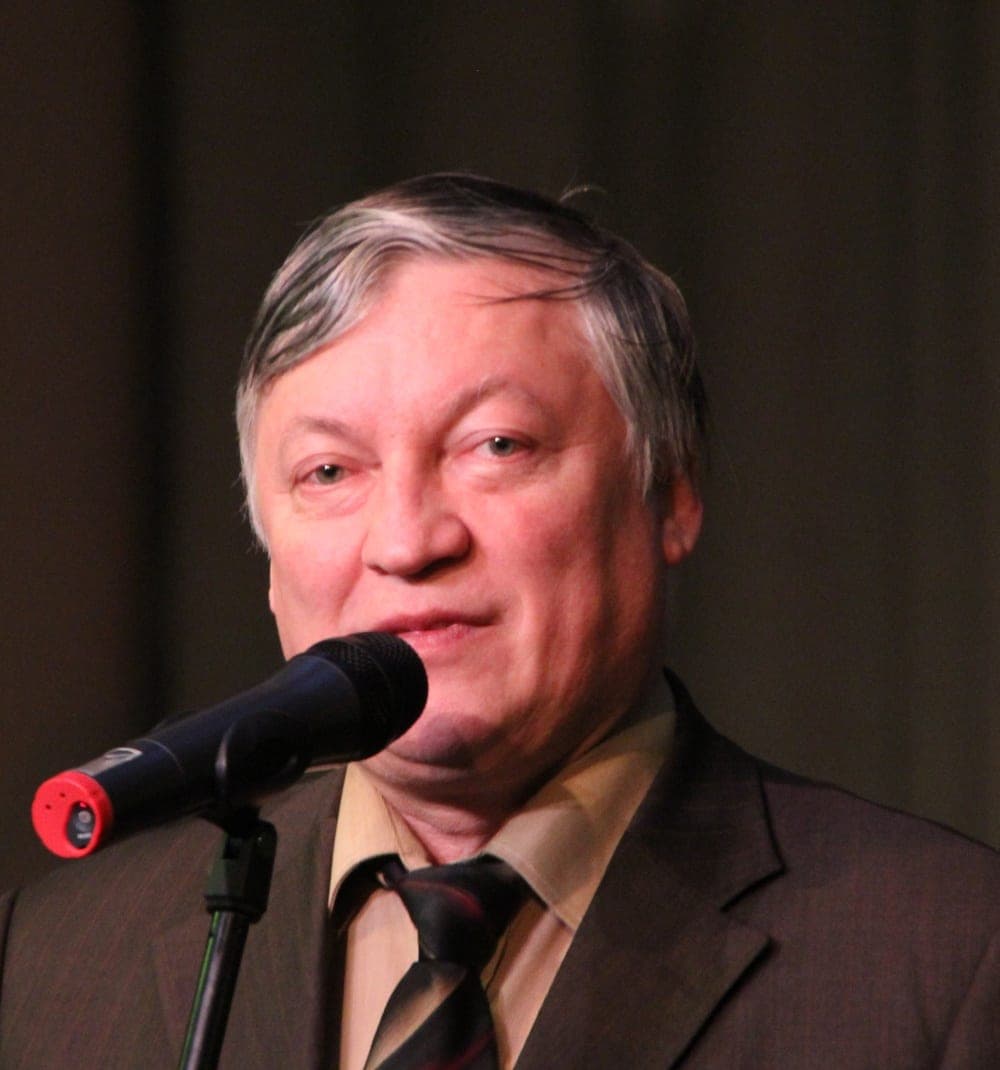
Photo by Ahsoous · CC BY 3.0 · Wikimedia Commons
A simple childhood in an industrial town
Anatoly Karpov was born in 1951 in Zlatoust, an industrial town in Russia's Ural Mountains. Unlike many other champions who showed astonishing talent from childhood, Karpov progressed more through perseverance, precision and disciplined learning. At 4 he learned the rules of chess from his father and very soon entered the official chess schools of the Soviet Union, a system that at that time had the best and most organized chess training in the world.
At 12 Karpov was accepted into Mikhail Botvinnik's famous summer school, where the best teenage talents of the Soviet Union were trained under the country's greatest coaches. Interestingly, Botvinnik himself didn't have a very positive assessment of Karpov's future at the time and thought his talent was limited; an assessment that later turned out to be completely wrong, as Karpov, through perseverance and hard work, totally disproved that prediction.
A strange championship: a crown won without playing
One of the strangest events in chess history is the start of Karpov's reign. In 1975, as the challenger, Karpov was to play America's Bobby Fischer, the reigning world champion. But Fischer, who was always a strange and demanding man, objected to the conditions and rules proposed by the world chess federation (FIDE) for the match and in the end gave up defending his title entirely.
That meant Karpov was automatically declared world champion without playing a single official championship game. Many questioned this strange start and said Karpov never got the chance to prove he could beat Fischer. But Karpov, with years of powerful play and successful defense of his title against the best in the world, proved to everyone that he truly deserved the position.
Karpov himself was always unhappy with this strange start; he said many times in interviews that he would have liked a real chance to play Fischer to settle once and for all who was better. But Fischer, who after the 1972 championship practically no longer agreed to play official games, never gave Karpov that chance; and that cast the shadow of an unanswered question over the beginning of Karpov's reign forever.
The legendary, endless battle against Kasparov
The most important and dramatic part of Karpov's career is his historic rivalry with the young Garry Kasparov. Between 1984 and 1990 the two played five world championship matches against each other; perhaps the longest and most intense two-player rivalry in chess history. Their first match, in 1984–85, is one of the strangest events in sports history: the match was meant to continue until one side won 6 games, but after 48 games (which took about five months!) with Karpov ahead 5 to 3, the then president of the world chess federation, citing the extreme fatigue of both players, declared the match stopped with no winner; a decision neither player agreed with and which is still counted among the most controversial decisions in chess history.
The next match was held in 1985 and this time Kasparov won by a narrow margin and, at 22, became the youngest world champion up to that time. But the story didn't end; in 1986, 1987 and 1990 Karpov again got a rematch and each time came close to beating Kasparov, but all five matches ended in Kasparov's favor in the end. That five-match rivalry not only pitted two people against each other but also displayed two completely different philosophies of chess.
The total of official games between Karpov and Kasparov in those five matches comes to more than 144; that is, in total these two have played each other more than any other two rivals in professional chess history. That large number of games let experts study both players' styles in depth and made the rivalry one of the best learning resources for high-level chess strategy.
The boa constrictor: a style that slowly squeezed the breath out of opponents
Karpov's playing style was exactly the opposite of Kasparov's. If Kasparov was an aggressive, fierce tiger, Karpov was more like a giant boa constrictor; an animal that doesn't just eat its prey but gradually, with constant pressure, coils around it until it can't breathe. Karpov loved calm, controlled positions; he was never in a hurry, took no unnecessary risks and, with incredible patience, restricted the opponent's freedom step by step until the opponent had no good move left.
That style led many experts to regard Karpov as one of the greatest strategists in chess history; someone who sought not beauty and show but the most efficient and reliable way to win. Even Garry Kasparov, his biggest rival, admitted many times that Karpov's understanding of complex positions and control of space was some of the deepest tactical and strategic knowledge he had seen in chess up to then.
Life after the crown: politics and diplomacy
Unlike many other champions who fade from the public eye after their peak, Karpov chose a different path. He entered Russian politics and served for years as a member of parliament (the Duma). He has also been an active cultural ambassador and supporter of chess education programs for children around the world, and is still one of the respected, influential figures in the chess world.
Karpov has also been one of the most active champions in history in charity; he founded the Karpov Peace Foundation, which helps children harmed by war and various disasters, including the Chernobyl nuclear disaster. These humanitarian activities show a different image of Karpov, beyond the cold, calculating personality he had at the chessboard.
Records and honors that get less attention
Many know Karpov only for his rivalry with Kasparov, but on his own he is one of the most decorated chess players in history. Karpov holds the record for the number of tournament victories; that is, in total he has won more major international tournaments than any other player in history. Years after losing the classical title to Kasparov, he also won the FIDE championship title again (the separate version of the title in the 1990s), which shows the extraordinary longevity of his career.
Another of Karpov's legacies is his role in developing opening theory; many of the important lines in the Caro-Kann and Slav defenses are the result of years of research and deep analysis by Karpov himself and his team. These analyses are still used in modern chess textbooks, and new generations of players, even without knowing it, are using Karpov's knowledge.
Karpov also holds another lesser-known statistic: the most consecutive years in the world top 10 rankings, before Magnus Carlsen came and broke many of those records. That means that even years after his peak as champion, Karpov stayed at the highest possible level; which shows his extraordinary mental and physical health over a career of several decades.
A curious passion for stamps and collecting
An interesting and lesser-known fact about Karpov is that he is one of the world's biggest collectors of postage stamps; Karpov's stamp collection is so large and valuable that it was even once recorded in the Guinness Book of Records. That curious passion for collecting and careful cataloguing reminds many of the precise, orderly style of his play; as if the same orderly mind he had at the chessboard worked the same way in his personal life.
Karpov has also been active in painting and the visual arts and has held several solo exhibitions of his work. That variety of interests shows a fuller picture of Karpov's personality, beyond the official, serious image we usually saw of him at world championship matches.
Why should we study Karpov's games?
If you want to learn how to win through patience, control of the position and restricting your opponent's options without needing big risks, Karpov's games are the best teachers. In Shatrino's Masters' Games section you can replay several of Karpov's real games.
Replay Anatoly Karpov's real games
In Shatrino's masters' games section, several of Anatoly Karpov's real games are available; replay them move by move.
Go to masters' games