

Alexander Alekhine
Alexander Alekhine · Russia / France · 1892
The only world champion who died with the crown on his head; a genius of breathtaking calculation and a mysterious fate.
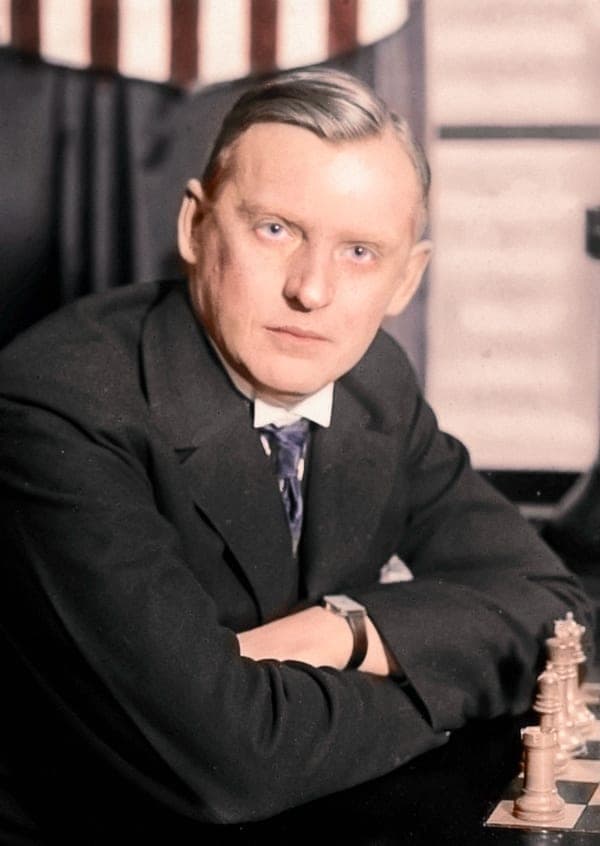
Photo by George Grantham Bain Collection (Library of Congress) · مالکیت عمومی (Public Domain) · Wikimedia Commons
An aristocrat who gave everything to chess
Alexander Alekhine was born in 1892 in Moscow into a wealthy Russian noble family. Unlike many later champions who came from ordinary or even poor families, Alekhine grew up in comfort; but that comfort never stopped his remarkable perseverance in becoming the best chess player in the world. He learned chess from his mother at 7 and very soon developed a strange obsession with the game.
The Russian Revolution of 1917 completely changed Alekhine's life. His noble family lost everything, and Alekhine was even arrested for a time by the Bolsheviks on spying charges and threatened with execution (though he was eventually released). Those hard experiences forced Alekhine to leave Russia for good and move to France, where he later took French citizenship.
Before that move, Alekhine had also studied law in Russia and even worked for a time as a lawyer; an educational background that shows he wasn't merely a chess prodigy but also had an analytical, orderly mind that probably helped his calculating precision at the chessboard as well.
A 34-game match against the greatest chess machine in the world
In 1927 Alekhine produced one of the greatest surprises in chess history. He had to play, in Buenos Aires, Argentina, Cuba's José Raúl Capablanca, the reigning world champion who was then called the "chess machine" because he almost never lost. Almost everyone, including Capablanca himself, thought it was an unequal match and Capablanca would win easily.
But Alekhine, with outstanding preparation and deep analysis of Capablanca's style, produced one of the longest and most draining matches in chess history: 34 games that lasted nearly two months. In the end Alekhine beat the invincible Capablanca with 6 wins, 3 losses and 25 draws and became the fourth world champion; one of the biggest surprises in the game's history.
To prepare for the match, Alekhine had trained for years in complete secrecy and with severe discipline; he even gave up much of his unhealthy habits so he could step into that historic battle in the best possible physical and mental condition. That level of sacrifice and preparation, in a chess era when scientific methods of preparation hadn't taken hold yet, was completely revolutionary.
A promise that was never kept
After that victory, one of the most debated parts of Alekhine's career began. Capablanca, following the custom of the time, asked for a rematch; but Alekhine, with various excuses, put it off for years and never played him. That ruined the relationship between the two geniuses forever, and many chess fans blamed Alekhine for it. Still, Alekhine defended his crown against other opponents and even once (1935) lost to the Dutchman Max Euwe, but two years later regained the crown in a rematch.
The 1935 loss to Euwe was unexpected for many, because Euwe, unlike Alekhine, wasn't a full-time professional player and his main job was teaching mathematics. That loss showed that even world champions can lose to opponents they underestimated if they aren't adequately prepared; and Alekhine, with his win in the rematch, learned the lesson of that defeat well and returned to the peak.
Breathtaking calculation and unforgettable combinations
Alekhine's style is known for his incredible calculating depth. He could calculate complex combinations many moves ahead with complete accuracy; an ability that was truly exceptional in that era, before analysis computers existed. One of his famous legacies is a formation called "Alekhine's Gun" (Alekhine's Gun); a particular arrangement of two rooks and a queen one behind the other on an open file that puts deadly pressure on the opponent's position and is still used in chess teaching today.
Alekhine was also one of the greatest simultaneous exhibition players in chess history; he broke the record for the number of simultaneous games several times, including a famous display in which, playing simultaneously and without seeing the boards (only hearing the moves and calculating in his head), he played dozens of different opponents and won most of them. That level of memory and mental calculation is unbelievable even today.
A mysterious and controversial end
Alekhine's life ended with a historical mystery. During World War II, articles bearing Alekhine's signature were printed in Nazi-controlled newspapers with antisemitic content; a subject that is still debated among historians, because some believe these articles weren't written by Alekhine himself or were forged or altered under Nazi pressure. That accusation put Alekhine in heavy social isolation after the war, and many European chess federations refused to work with him.
In 1946 Alekhine was found dead, suddenly and mysteriously, in a small hotel in Estoril, Portugal, while still holding the world championship title. That means Alekhine is the only champion in chess history who died with the crown on his head, since he never lost it in a match. The exact cause of his death is still not completely clear and various theories, from choking on food to political involvement, have been put forward.
After his death, the world chess federation (FIDE), which had only recently been founded, decided never again to let the world championship title be left vacant like that without an official match; that decision led to the modern system of world championship matches that continues today (with changes). So even Alekhine's death, in a roundabout way, influenced the future organization of professional chess.
Alekhine's body was buried in Montparnasse Cemetery in Paris, and his gravestone is carved with a chessboard. Years later the world chess federation officially cleared Alekhine of any charges related to the antisemitic articles and declared the case closed; an action that was part of the effort to remove a historical stain from the record of one of the greatest geniuses of the game.
A legacy that is still alive
Despite all the controversies, no one can deny the depth and beauty of Alekhine's games. His own analytical books on games from major tournaments, including "My Best Games of Chess", are still counted among the most outstanding works of chess literature; works that show Alekhine was not only an extraordinary player but also a talented writer and analyst.
Alekhine's name is still carved on various tournaments around the world, especially in France and Russia, and his legacy as one of the greatest tactical geniuses in chess history lives on; someone who showed that chess can be both science and pure calculating art.
A man of several languages and several lives
Alekhine was one of the most multilingual champions in chess history; he spoke Russian, French, German and English fluently, and that language ability let him easily connect with the media and local audiences in whatever country he lived. That, together with his always elegant appearance and aristocratic manner, created the image of a "cosmopolitan chess player" who adapted to any culture.
Still, Alekhine's life was never truly calm; war, revolution, forced emigration and later political accusations meant he always lived in a kind of instability. Perhaps that constant instability is why Alekhine found his real refuge only on the chessboard; the place where, unlike the outside world, he had complete control of things.
Why should we study Alekhine's games?
If you love complex combinations and deep calculation that sees many moves ahead, Alekhine's games are a real treasure. In Shatrino's Masters' Games section you can replay several of Alekhine's historic games.
Replay Alexander Alekhine's real games
In Shatrino's masters' games section, several of Alexander Alekhine's real games are available; replay them move by move.
Go to masters' games